
Badminton Court Construction Cost in India (2026 Guide)
Badminton court construction cost in India: court size and run-off, flooring prices per sq ft, lighting, roofing, and worked examples for 1 to 4 indoor courts.
Badminton court construction cost in India runs from about ₹3 lakh for a basic outdoor acrylic court to ₹15–60 lakh for one indoor court with a roof, flooring and lights, based on Indian builder estimates (Pace Court; AQS). A four-court indoor hall is commonly quoted between ₹40 lakh and ₹1.2 crore. Costs vary by city, flooring type and above all the roof, so treat every figure here as a range to check against your own quotes.
This guide covers the court size and the space you really need, roof height, flooring prices per sq ft, lighting, roofing, worked examples for one, two and four courts, the timeline, what players pay and what to ask your contractor.
Badminton court size and the space you need
The court itself is small. The space around it is what decides your plot.
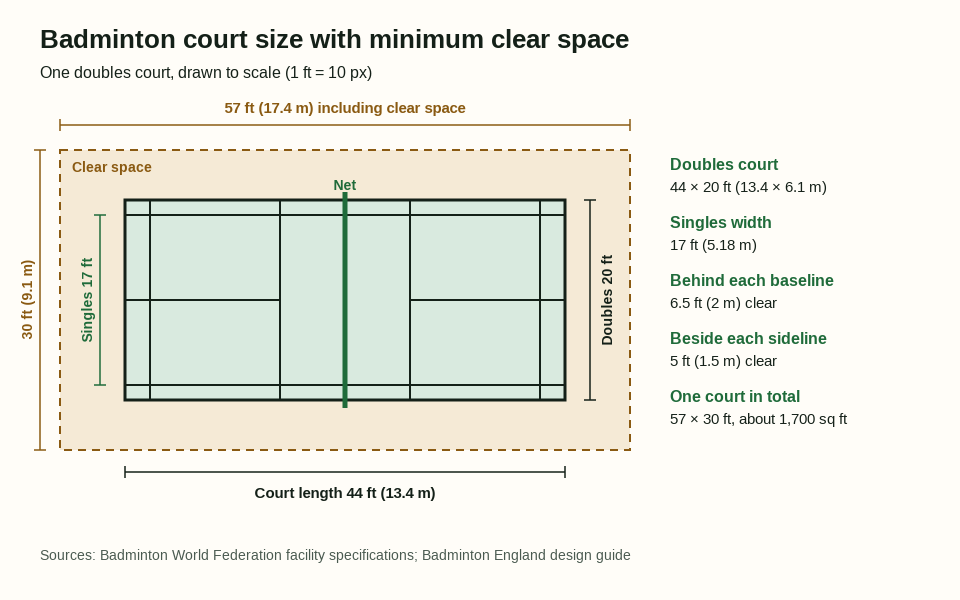
A doubles badminton court is 13.4 m long and 6.1 m wide, which is 44 × 20 ft; singles uses a narrower width of 5.18 m, or 17 ft (Badminton England). The Badminton World Federation's facility specifications ask for at least 2 m (about 6.5 ft) of clear space behind each baseline and 1.5 m (about 5 ft) beside each sideline, and the same 1.5 m between courts laid side by side (Badminton World Federation).
| Area | Feet | Square feet | Metres (approx.) |
|---|---|---|---|
| Doubles court (lines) | 44 × 20 | 880 | 13.4 × 6.1 |
| Singles width | 17 ft | – | 5.18 |
| One court with minimum clear space | 57 × 30 | about 1,700 | 17.4 × 9.1 |
| Two courts side by side | 57 × 55 | about 3,135 | 17.4 × 16.7 |
| Four courts side by side | 57 × 105 | about 5,985 | 17.4 × 31.9 |
The multi-court rows are worked out from the BWF clearances: each extra court adds 20 ft of court plus 5 ft of gap. These are minimums for the playing area only. Add a walkway, seating, a reception desk, toilets and parking on top.
Roof height for an indoor badminton court
Height is the one thing you cannot fix after the roof goes up. Badminton England's design guide gives these clear heights above the court:
| Level of play | Clear height |
|---|---|
| Absolute minimum, recreational | 6.1 m (about 20 ft) |
| Accepted for higher-level play in existing halls | 7.5 m (about 24.6 ft) |
| Preferred | 9 m (about 29.5 ft) |
| BWF sanctioned tournaments | 9 m; 12 m for top events (Badminton World Federation) |
The height must be clear of trusses, fans and lights over the court. Players lift the shuttle high in rallies, and a low roof is the most common complaint in cheap halls. If you are fitting courts into an existing godown or a building in Chennai, measure the lowest beam, not the ridge.
Badminton court cost per sq ft by flooring
Flooring is where quotes differ most. Here are the published ranges side by side.
| Flooring | Price per sq ft | Source |
|---|---|---|
| Synthetic PU | ₹180 – ₹320 | AQS |
| Synthetic / PVC | ₹180 – ₹350 | Pace Court |
| PVC synthetic mats | ₹350 – ₹900 | ChampCourts |
| Vinyl / PVC roll | ₹80 – ₹180 | AQS |
| Wooden (maple) | ₹450 – ₹900 | AQS |
| Wooden | ₹350 – ₹800 | Pace Court |
| Wooden courts | ₹2,500 – ₹4,000 | ChampCourts |
| Acrylic | ₹120 – ₹250 | Pace Court |
| Acrylic hard court | ₹60 – ₹120 | AQS |
The sources disagree, sometimes widely, especially on wood. That usually comes down to what is included: a mat rolled out on your slab, or a full sprung subfloor with battens, shock pads and finish. Ask each builder for the thickness, the brand, the warranty and whether the base is in the price.
Which flooring suits which hall
- Pay-and-play hall: synthetic PU or PVC mats. Good grip and cushioning, and the price sits in the middle.
- Academy or tournament venue: a wooden sprung floor, if your budget allows. It costs more and needs care with humidity.
- Outdoor or budget court: acrylic on a concrete base. Cheaper, but harder on knees and affected by wind, which matters a lot with a shuttle.
Civil base, lighting, roofing and equipment
The floor needs something under it and something over it.
| Item | Price range | Source |
|---|---|---|
| Civil base work | ₹250 – ₹450 per sq ft | Pace Court |
| Roofing shed listings for badminton courts | ₹110 – ₹1,250 per sq ft, most ₹200 – ₹400 | IndiaMART listings |
| Indoor shed / PEB structure | ₹800 – ₹1,500 per sq ft | AQS |
| Steel structure / PEB | ₹1,200 – ₹2,000 per sq ft | Pace Court |
| LED lighting, indoor | ₹2 – ₹5 lakh per court | Pace Court |
| LED lighting, four courts | ₹3.5 – ₹18 lakh | AQS |
| Nets and poles | ₹25,000 – ₹2 lakh | Pace Court |
Roof: open shed or full building
A simple roofing shed over open sides is the cheaper route, and many listings sit around ₹200 – ₹400 per sq ft. A full pre-engineered building with walls, insulation and the height you need costs several times more per sq ft. Two things push the price up: height (you need at least 20 ft clear, ideally more) and wind control. A shuttle drifts in even a light breeze, so open sides can cost you serious players. In Chennai's heat and rain, ask about insulated sheets, ventilation and gutters too.
Lighting
Badminton England recommends an average of 500 lux for club and recreational courts, with lights kept off the area directly above the court so players are not dazzled. BWF requires at least 1,000 lux for its higher-grade tournaments (Badminton World Federation). For a pay-and-play hall, 500 lux done well, with lights along the sides, is what most players will notice.
Example: one, two and four indoor courts
Example. This is not a quote. It multiplies the sourced ranges above by the minimum areas from the size table, for a synthetic PU floor under a roofing shed on land you already own.
| Item | Rate used | 1 court (1,710 sq ft) | 2 courts (3,135 sq ft) | 4 courts (5,985 sq ft) |
|---|---|---|---|---|
| Civil base | ₹250 – ₹450 /sq ft | ₹4.3 – ₹7.7 lakh | ₹7.8 – ₹14.1 lakh | ₹15 – ₹26.9 lakh |
| Synthetic PU floor | ₹180 – ₹320 /sq ft | ₹3.1 – ₹5.5 lakh | ₹5.6 – ₹10 lakh | ₹10.8 – ₹19.2 lakh |
| Roofing shed | ₹200 – ₹400 /sq ft | ₹3.4 – ₹6.8 lakh | ₹6.3 – ₹12.5 lakh | ₹12 – ₹23.9 lakh |
| LED lighting | ₹2 – ₹5 lakh per court | ₹2 – ₹5 lakh | ₹4 – ₹10 lakh | ₹8 – ₹20 lakh |
| Nets and poles | ₹25,000 – ₹2 lakh per court | ₹0.25 – ₹2 lakh | ₹0.5 – ₹4 lakh | ₹1 – ₹8 lakh |
| Total | ₹13 – ₹27 lakh | ₹24.3 – ₹50.7 lakh | ₹46.7 – ₹98 lakh |
For one court, the low end is ₹4,27,500 + ₹3,07,800 + ₹3,42,000 + ₹2,00,000 + ₹25,000 = ₹13,02,300. Redo each line with your own quotes.
These totals line up with published builder ranges: ₹15 – ₹35 lakh for a standard single PU court (AQS) and ₹40 – ₹60 lakh for a turnkey four-court facility (ChampCourts). They leave out land, boundary walls, toilets, changing rooms, an electricity connection, approvals and GST. A full PEB building instead of a shed can add a lot: at ₹800 – ₹1,500 per sq ft (AQS), the roof alone for four courts would be about ₹48 lakh to ₹90 lakh.
How long construction takes
Builders quote about 6 to 12 weeks for an indoor facility (AQS) and 12 to 20 weeks for a four-court complex (AQS). Plan around these stages:
- Site and approvals: survey, soil check, building and electrical approvals.
- Civil base: excavation, compaction and a level concrete slab. Concrete needs time to cure before flooring goes on.
- Steel structure and roof: fabrication can take weeks before anything arrives on site.
- Flooring, lines and lights: the last and quickest step, done once the roof keeps the rain out.
Avoid laying the base in the peak of the north-east monsoon if you are building in Chennai.
What players pay and how you earn
Court hire is the main income. In Chennai, LBB lists group rates of about ₹400 – ₹500 an hour at several halls, and one venue charging ₹600 on weekdays and ₹800 on weekends for a non-AC court and ₹1,400 an hour for its AC court (LBB). Across India, AQS puts metro peak rates at ₹500 – ₹700 an hour and off-peak at ₹250 – ₹400.
Example. One court at ₹500 an hour, booked 6 hours a day: 6 × 30 = 180 hours a month, and 180 × ₹500 = ₹90,000 a month before costs. With four courts at the same rate and hours, that is ₹3,60,000. New halls rarely fill evenings at once, so try the sum again at 3 or 4 hours a day.
Other income ideas: coaching batches in the mornings and early evenings, monthly memberships for regular groups, weekend tournaments and racket rental. Our guide on how to price your turf per hour explains peak and off-peak pricing, and the same 44 × 20 ft floor can also take pickleball lines, as covered in pickleball court cost in India.
What to check with contractors
Get at least three written quotes and compare them line by line.
- Clear height under the lowest truss, fan or light, in writing.
- Area covered: court only, or court plus the 6.5 ft and 5 ft clear space?
- Flooring: brand, thickness, shock-pad or subfloor, and whether the base is included.
- Lighting: fixture count, wattage, lux level promised and where the lights hang.
- Roof: sheet type, insulation, ventilation, side cladding and gutters.
- Warranty on flooring, roof and lights, and what voids it.
- Payment stages tied to finished work, not dates.
- Exclusions: GST, transport, electrical connection, line marking and nets.
Visit one hall each builder has finished, play a game there and ask the owner how the floor has held up.
How Turf Access helps
Once your courts are ready, Turf Access gives your venue its own booking link and a shared WhatsApp booking number. Players pick the day, court, time and length, pay the advance straight to your UPI ID and tap Payment done; you check your UPI app and confirm. There is no commission, and Turf Access never holds player money.
You can set peak, weekend and off-peak prices per court, add walk-ins and phone bookings for free, and keep regular slots and memberships for your morning groups. Badminton is one of 13 sports supported. See how the turf booking software works; new venues get 20 free credits to start.
Frequently asked questions
How much does it cost to build a badminton court in India?
Indian builders quote roughly ₹3 lakh to ₹12 lakh for one outdoor acrylic court and about ₹15 lakh to ₹60 lakh for one indoor court with flooring, a roof and lights. The cost depends on the city, the flooring type, whether you build a shed or a full building, and whether you already own a level slab. Land is extra.
What is the size of a badminton court in feet?
A badminton court is 44 ft long and 20 ft wide for doubles. For singles, the width is 17 ft. With the minimum clear space the Badminton World Federation asks for, about 6.5 ft behind each baseline and 5 ft at each side, one court needs roughly 57 × 30 ft, or about 1,700 sq ft.
How high should the roof be for an indoor badminton court?
Badminton England's design guide treats about 20 ft (6.1 m) as the absolute minimum for recreational play, accepts 24.6 ft (7.5 m) for higher-level play in existing halls and prefers 29.5 ft (9 m). BWF tournaments need 9 m to 12 m. A low roof stops players from lifting the shuttle and is very hard to fix later.
Which flooring is best for a commercial badminton court?
Most pay-and-play halls use synthetic PU or PVC mat flooring because it gives good grip and cushioning at a moderate price. Wooden sprung floors cost more and need more care but are preferred for tournaments. Acrylic is cheaper and suits outdoor or budget courts, though it is harder on the knees.
How long does it take to build an indoor badminton court?
Builder estimates range from about 6 to 12 weeks for a simple indoor court to 12 to 20 weeks for a four-court complex. Approvals, monsoon delays and the steel structure lead time can add more, so plan your opening date with a buffer.