
Turf Price Per Hour in India: ₹800–₹2,000 by City
Turf price per hour in India is about ₹800–₹2,000, box cricket ₹800–₹1,500, or ₹80–₹200 a player. City rates, weekend prices and how owners set them.
Turf price per hour in India is commonly around ₹800 to ₹2,000 for a football or multi-sport turf and ₹800 to ₹1,500 for box cricket, according to Franchise India. Your right price depends on your city, area, turf size, surface and the time of day. Most owners charge more for evenings and weekends and less for quiet daytime slots.
This guide shows what turfs charge in a few cities, how to set peak, off-peak and weekend prices, a worked weekly price grid, how to handle advances, group and membership pricing, and how to review prices each month.
Typical turf price per hour in Indian cities
Prices vary widely, even inside one city. Treat the figures below as a starting point, not a rule.
| Source | What it shows |
|---|---|
| Franchise India | Turfs ₹800–₹2,000 an hour; box cricket ₹800–₹1,500 an hour; tournaments ₹5,000–₹20,000 an event |
| KheloMore | Uses ₹1,200 an hour as a mid-range box cricket example; markets range from about ₹800 to ₹2,000 an hour |
| JSD Turf, Chennai | ₹599 an hour on weekdays and ₹699 an hour on weekends (one venue's published rates) |
| Hudle, Bengaluru football listings | "From" prices mostly ₹250–₹400, ranging from under ₹100 to over ₹2,000 |
A note on listing prices: marketplace pages often show the lowest "onwards" price. That may be an off-peak slot, a shorter slot or a smaller court. Do not copy it as your peak rate.
Cricket turf price per hour vs football turf price per hour
On a shared turf, many owners charge the same hourly rate for both sports. Some charge a little more for cricket turf rent per hour, because groups book longer slots and wear the turf near the crease. The simplest way to decide is to see which sport fills your evenings and price that one first.
Turf price per person
Players often think in price per person, because a group splits the turf price for 1 hour between everyone who plays. The sum is simple: hourly price ÷ number of players.
Example. At the published range of ₹800 to ₹2,000 an hour (Franchise India), a 5-a-side football game with 10 players costs ₹80 to ₹200 each. With 14 players for 7-a-side, the same hour costs about ₹57 to ₹143 each.
Showing a per person figure next to your turf rent per hour can help a group decide quickly, especially students on a budget. Keep the hourly price as the real price on your booking page.
The best way to find your local price
- List five turfs within 5 km of yours.
- Note their weekday evening and weekend prices, from their booking pages or by calling.
- Visit two of them at 8 pm on a weekday and count how many courts are in use.
- Place yourself in the range based on your turf's size, surface, lighting, parking and toilets.
How to set peak, off-peak and weekend prices
KheloMore notes that 6 pm to 10 pm are peak hours in most Indian cities, and that without floodlights you lose those evening bookings. That gives you a natural price structure.
| Time band | When | Price idea |
|---|---|---|
| Peak | Weekday evenings, roughly 5 pm to midnight | Your highest rate |
| Off-peak | Weekday mornings and afternoons | Lower rate to attract schools, coaching and office groups |
| Weekend | Saturday and Sunday | A premium, especially mornings and evenings |
| Late night | After 11 pm, if you stay open | Test a small discount to fill the last slots |
Tips that keep peak hour pricing fair:
- Keep the gap reasonable. A very deep off-peak discount can make players wonder what is wrong with the slot, and can pull your peak regulars into cheaper hours. A modest gap feels like a deal.
- Show prices clearly. Put every band on your booking page. Surprises at the counter lose regulars.
- Change prices on clean boundaries. "₹1,200 from 5 pm" is easier to understand than prices that change every hour.
Worked example: a weekly price grid and its effect on revenue
Example. These prices sit inside the published range above, but the occupancy figures are assumptions. Replace them with your own.
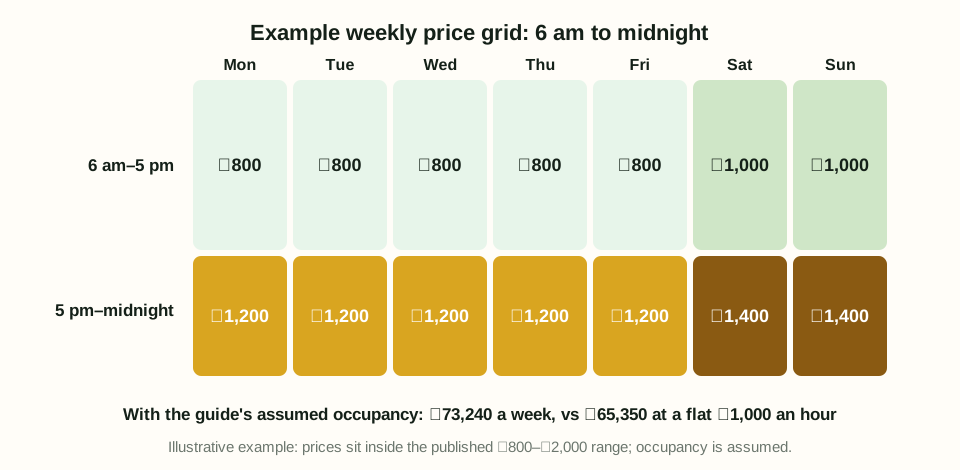
Assume one turf open 6 am to midnight (18 hours a day). Split the week into four bands:
| Band | Hours per week | Price per hour | Assumed occupancy | Booked hours | Revenue |
|---|---|---|---|---|---|
| Weekday off-peak (6 am–5 pm) | 11 × 5 = 55 | ₹800 | 25% | 13.75 | ₹11,000 |
| Weekday peak (5 pm–midnight) | 7 × 5 = 35 | ₹1,200 | 80% | 28 | ₹33,600 |
| Weekend day (6 am–5 pm) | 11 × 2 = 22 | ₹1,000 | 50% | 11 | ₹11,000 |
| Weekend peak (5 pm–midnight) | 7 × 2 = 14 | ₹1,400 | 90% | 12.6 | ₹17,640 |
| Week total | 126 | 65.35 | ₹73,240 |
Now compare a flat ₹1,000 an hour for the same 65.35 booked hours: 65.35 × ₹1,000 = ₹65,350. The price grid earns ₹7,890 more each week, or about ₹31,500 over four weeks, without a single extra booking.
The grid also gives you a lever for the quiet hours. If the ₹800 off-peak rate lifts weekday daytime occupancy from 25% to 35%, that band earns 55 × 0.35 × ₹800 = ₹15,400 instead of ₹11,000, another ₹4,400 a week.
Try the same sum with your own hours and prices. If you want to see how revenue turns into profit, our guide on whether a turf business is profitable in India walks through costs.
Advance amount and cancellation rules
A no-show at 8 pm on a Friday is money you cannot get back. An advance protects you.
- Fixed or percentage. Some owners take a fixed amount per slot; others take a share of the price. Pick one and keep it simple.
- Higher advance for peak slots. Peak slots are the ones you lose most on. A larger advance there is fair.
- Clear refund rules. For example, full refund or reschedule if cancelled 24 hours ahead, no refund after that. Write the rule on the booking page and in the confirmation message.
- Collect it straight to your UPI. If you take bookings through a marketplace, check what share it keeps. Our post on marketplace commission vs your own booking link explains the difference.
Group, membership and regular-slot pricing
Not every booking should pay the same rate. A few structures that work:
Regular slots
A group that plays every Tuesday at 7 pm is your most valuable customer. Hold that slot for them every week. A small discount in return for booking a month at a time keeps them loyal and fills your peak calendar early.
Memberships
Example. A monthly membership of eight off-peak hours for ₹5,600 (₹700 an hour instead of ₹800) gives a player a reason to come in daytime, and gives you money in advance for slots that might stay empty.
Corporate and tournament bookings
Office groups and tournaments book many hours at once. Franchise India puts tournament bookings at ₹5,000–₹20,000 an event. Quote a package price rather than an hourly rate, and take a larger advance.
Coupons
Use coupons for specific goals: first booking, a slow afternoon, or a festival week. Give each coupon an end date so it does not become your new normal price.
How to review prices every month using occupancy
Occupancy tells you whether a price is right. For each time band, work out:
Occupancy = booked hours ÷ available hours
Then use a simple rule of thumb (our suggestion, not a market figure):
| Occupancy in the band | What to do |
|---|---|
| Above 85% | Raise the price a little, say ₹50–₹100, next month |
| 50–85% | Keep the price; look at marketing instead |
| Below 30% | Try an offer, a membership or a coaching batch for that band |
Also check:
- Which days of the week are weakest, not just which hours.
- How many bookings were cancelled or were no-shows.
- Whether new regular groups started or stopped.
Change one thing at a time and give it a full month. Otherwise you will not know what worked.
How Turf Access helps
Turf Access lets you set peak, weekend and off-peak price rules per court by day and time, so the right price appears on your booking link and in WhatsApp bookings without you working it out each time. You can also set up regular slots, memberships and coupons.
Players pay the advance straight to your UPI ID and tap Payment done; you check your UPI app and confirm. There is no commission, and walk-in and phone bookings you add are free. The day's board shows every court, which helps when you review occupancy each month. See how our turf booking software works; new venues get 20 free credits.
Frequently asked questions
What is the average turf price per hour in India?
Published estimates put turf bookings at roughly ₹800 to ₹2,000 an hour and box cricket at ₹800 to ₹1,500 an hour. Prices vary a lot by city, area, turf size, surface and time of day, so check the turfs near you before you set your own.
What is the turf price per person?
Divide the hourly price by the number of players sharing the slot. For example, at ₹800 to ₹2,000 an hour, a 5-a-side football game with 10 players works out to about ₹80 to ₹200 each for one hour. Bigger groups pay less each, which is why players often fill every spot before booking.
What are peak hours for a turf?
In most Indian cities, evenings from about 6 pm to 10 pm are the busiest, because that is when people finish work and college. Weekend mornings and evenings are also strong. Early weekday mornings and afternoons are usually the slowest.
How much should I charge extra on weekends?
There is no fixed rule. One Chennai turf, for example, publishes ₹599 an hour on weekdays and ₹699 an hour on weekends. Start with a small premium, watch how full your weekend slots are, and adjust each month.
How much advance should I take for a turf booking?
Take enough to cover your loss if the group does not turn up, since you cannot resell a slot at the last minute. Many owners take a fixed amount or a share of the slot price. Write your cancellation and refund rules clearly on the booking page.
How often should I change my turf prices?
Review prices once a month using occupancy for each time band. Raise prices slowly where slots sell out, and try offers or memberships where slots stay empty. Avoid changing prices every week, because regular players dislike surprises.