
Box Cricket Business: Investment, Plan and More Bookings
Box cricket business in India: investment, running costs and earnings at a glance, then 10 practical ways to fill empty slots and get more bookings.
The fastest way to grow a box cricket business is to make booking effortless and then fill the hours that sit empty. Put a booking link where players already look (Google Maps, Instagram, WhatsApp), price quiet hours lower, and lock in regular weekly teams, leagues and corporate groups. First, a quick look at the investment and earnings. Then 10 practical ways to get more bookings, each with a short how-to you can start this week.
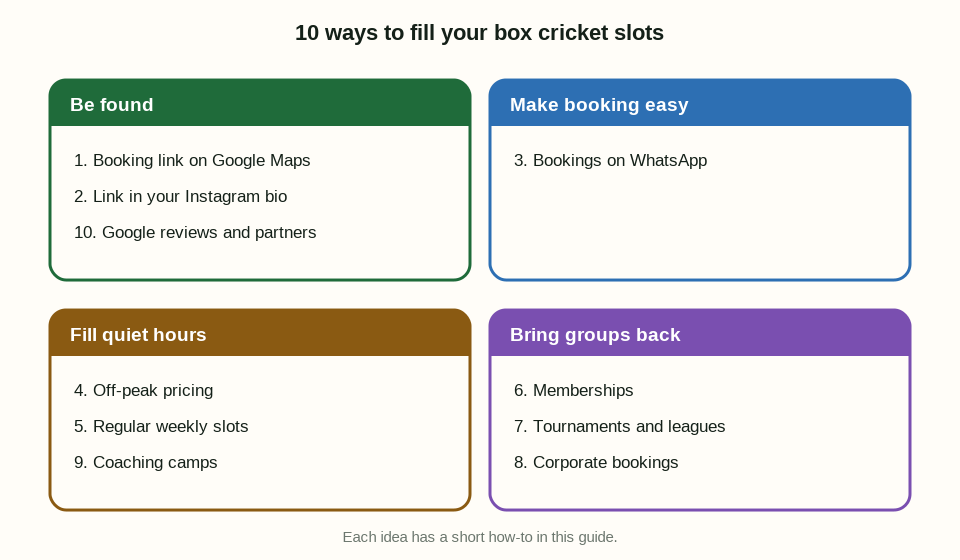
Box cricket business at a glance: investment and earnings
If you are still planning, these are the numbers people ask about most. All of them vary by city, land and materials, so use them to check your own quotes, not as a forecast.
| Item | Published figure | Source |
|---|---|---|
| Build cost in Chennai | ₹260–400 per sq ft; about ₹8–10 lakh for 2,400 sq ft | HRK Sports Infra |
| Minimum box cricket setup on rented land | ₹10–15 lakh | TurfBox |
| Hourly rate for box cricket and turf bookings | ₹800–2,000 | Franchise India |
| Monthly running costs | Rent ₹30,000–80,000, electricity ₹15,000–35,000, staff ₹25,000–50,000 | TurfBox |
| Payback | 8–18 months (TurfBox) to 1.5–3 years (A.S Sports and Infra) | As named |
The build is the biggest box cricket business cost, and the land or lease deposit sits on top of it. For a line-by-line budget, see turf construction cost in Chennai.
Earnings come down to hours sold. Franchise India's own illustration shows about ₹1.2 lakh a month at 4 booked hours a day, rising to ₹3 lakh at 10 booked hours, on the same court (Franchise India). Rent, power and staff stay roughly the same either way, so every extra hour you fill improves profit. For a worked profit and payback example you can redo with your own numbers, read is turf business profitable in India.
That is why the rest of this guide is about filling hours.
Why slots sit empty in a box cricket business
Most turfs have the same pattern. Evenings and weekends book themselves. Weekday mornings and afternoons stay quiet. And some genuine players give up because they couldn't reach you, or didn't hear back in time.
So there are two jobs:
- Don't lose the players who already want to book. Make it quick and clear.
- Create demand for the quiet hours. Give specific groups a reason to come at those times.
Keep a simple note for two weeks of which hours go unsold. Every idea below works better when you know exactly which slots you're trying to fill.
1. Put a booking link on Google Maps
When someone searches "box cricket near me", your Google Business Profile is often the first thing they see. Google lets businesses add booking links, with up to 10 links per category for actions like "Book an appointment" or "Make a reservation" (Google Business Profile Help).
How to:
- Sign in to your Business Profile on Google Search or Maps.
- Open the bookings section, choose "Add link" and paste your booking page.
- Check your hours, phone number and photos while you're there. Wrong hours lose bookings.
2. Add the booking link to your Instagram bio
Players check Instagram to see the turf, the lights and the crowd. Instagram lets you add a website link from Edit Profile on your profile (Instagram Help).
How to:
- Put your booking link in the bio, with one line such as "Book your slot here".
- Post short clips of real matches, especially night games under the lights.
- In every post's caption, say "Link in bio to book".
3. Take bookings on WhatsApp
Many players in India would rather send a WhatsApp message than fill a form. The WhatsApp Business app offers automated greeting and away messages, quick replies for common questions, and labels to organise chats (WhatsApp Business).
How to:
- Set a greeting message with your prices, address and booking link.
- Save quick replies for "Is 8 pm free?", "What's the rate?" and "Where are you located?".
- Use labels such as "Paid", "To confirm" and "Regular team".
- Reply fast. A player who waits too long books somewhere else.
Our guide to turf booking on WhatsApp walks through the full setup.
4. Use off-peak pricing for quiet hours
A lower rate for weekday mornings and afternoons gives price-conscious groups (students, shift workers, casual players) a reason to come when you'd otherwise be empty.
How to:
- Set three rates: peak (weekday evenings), weekend, and off-peak.
- Make the off-peak discount big enough to notice, and say it clearly: "Weekdays 6 am–4 pm: lower rate".
- Don't discount evenings that already sell out.
Example: if your off-peak rate is ₹800 an hour and you sell 2 extra off-peak hours a day for 26 days a month, that is 2 × 26 × ₹800 = ₹41,600 of extra revenue a month from hours that earned nothing before. Redo this with your own rate. For setting the rates themselves, see how to price your turf per hour.
5. Sell regular weekly slots to office teams and schools
A team that plays every Tuesday at 7 pm is worth far more than one random booking. Regular slots give you predictable income and fewer gaps to chase.
How to:
- Make a list of IT parks, offices, colleges, schools and apartment complexes within a few kilometres.
- Offer a fixed weekly slot at a set rate, booked for a month or a term at a time.
- Schools and coaching academies are a good fit for weekday mornings and afternoons, which are usually your quiet hours.
- Send a reminder the day before so regulars don't forget.
6. Offer memberships
A membership turns occasional players into regulars. It also brings in money upfront.
How to:
- Keep it simple: a set number of hours a month, or a monthly pass for off-peak hours.
- Give members something real: priority on popular slots, a better rate, or a free hour after a set number of bookings.
- Write the terms down: validity, which hours are included, and what happens to unused hours.
7. Run box cricket tournaments and leagues
A box cricket tournament fills slots, brings spectators and gets people talking about your turf. A league does the same for weeks at a time.
How to:
- Choose a format: a one-day knockout for quick buzz, or a weekly league over 4–6 weeks for steady bookings.
- Fix team size, overs, entry fee, prizes and rules before you announce.
- Schedule league matches in quieter slots and keep the final for a busy evening when friends come to watch.
- Collect entry fees by UPI before the first match.
- Post results and photos on Instagram and in your WhatsApp groups after each round.
Corporate leagues (office vs office) work especially well, and an office team that enjoys a league often comes back as a regular slot.
8. Go after corporate bookings
Companies book turfs for team outings, inter-department matches and Friday evening games.
How to:
- Reach HR and admin teams at nearby offices with a one-page offer: slot options, rates, what's included (balls, bibs, drinking water).
- Offer a package for 2–3 hours with snacks arranged through a local vendor.
- Give a simple GST invoice if they need one.
- After the event, invite them to book a monthly or weekly slot.
9. Host coaching camps
Coaching brings in young players and their parents, and it uses the hours adult teams don't want.
How to:
- Partner with a local coach or academy. They bring the students; you provide the turf.
- Run camps in school holidays and on weekday mornings.
- Agree in writing on the fee split or the slot rate, timings and who handles parent communication.
- Invite camp families to book the turf for weekend games.
10. Get more Google reviews, and build local partnerships
Reviews help new players trust you. Google suggests asking customers to leave a review through a Google link or QR code, and replying to reviews (Google Business Profile Help). Google also says offering free or discounted services in exchange for reviews is prohibited, so ask, but don't reward.
How to:
- Print your review QR code near the exit and the counter.
- Send the review link in your post-match WhatsApp message: "Thanks for playing! Tell us how it went."
- Reply to every review, good or bad, politely and briefly.
Partnerships work the same way: local trust, shared audiences.
- Sports shops: display their bats and balls; they display your flyer.
- Cafes and juice shops nearby: a small offer for players after a match.
- Apartment associations and college clubs: a fixed slot for their members.
- Local cricket coaches and WhatsApp groups: a referral offer for teams they send.
Putting it together
You don't need all ten at once. Start with the basics that stop lost bookings: a booking link on Google and Instagram, and fast WhatsApp replies. Then pick one or two ideas aimed at your emptiest hours, such as off-peak pricing and a school or corporate regular slot. Review your unsold hours every month and add the next idea.
How Turf Access helps
Turf Access gives your turf a booking link (turfaccess.com/book/your-venue) that you can put on Google Maps and Instagram, and booking through a shared WhatsApp number where players pick the day, court, time and length. Players pay the advance straight to your own UPI ID, with no commission.
From your phone you can set peak, weekend and off-peak prices per court, and run regular (repeat) slots, memberships, coupons and tournaments. Players get WhatsApp reminders and confirmations, and you get alerts for new bookings and payments to check. Walk-ins and phone bookings you add are free. Setup takes about five minutes. See our box cricket booking software.
Frequently asked questions
How much investment is needed for a box cricket business?
Published estimates put a minimum box cricket setup on rented land at about ₹10 to 15 lakh. One Chennai builder quotes about ₹8 to 10 lakh to build a 2,400 sq ft court, before the lease deposit, washrooms and CCTV. Your total depends on court size, grass, lights and whether you lease or buy the land.
How can I get more bookings for my turf?
Make booking easy first: put a booking link on Google Maps and Instagram and answer WhatsApp quickly. Then fill quiet hours with off-peak prices, regular weekly slots for office teams and schools, memberships and leagues. Ask happy players for Google reviews so new teams find you.
How do I fill weekday afternoon slots at a box cricket turf?
Afternoons suit schools, coaching camps, college teams and shift workers. Offer a lower off-peak rate, approach nearby schools and academies with a fixed weekly slot, and run short coaching camps during holidays. Track which hours stay empty so you can target them.
How do I organise a box cricket tournament at my turf?
Fix the format, team size, entry fee, prize and dates first. Use your quieter slots for league matches and keep finals for a busy evening when friends come to watch. Share the fixture list on WhatsApp and Instagram, and collect entry fees by UPI before the first match.
Can I offer discounts to customers for Google reviews?
No. Google's Business Profile rules say offering free or discounted goods or services in exchange for reviews is prohibited. Simply ask players for honest feedback with your review link or QR code, and reply to every review.
Is a box cricket business profitable?
It depends on your build cost, rent and how many hours you sell each day. Filling a few extra off-peak hours every week often makes the biggest difference, because your fixed costs stay the same. Work out your own numbers with your rate, booked hours and monthly costs.