
Is Turf Business Profitable in India? Investment and Profit
Is turf business profitable in India? Investment cost, running costs, profit margin and payback, with a worked example and why some turfs fail to fill slots.
Yes, a turf business can be profitable in India, but only when it sells enough paid hours. Your income is simply the hours you sell multiplied by your price per hour, while rent, power and staff stay roughly the same whether the turf is full or empty. A well-placed turf that fills its evenings and weekends can pay back the investment in one to three years; a turf in the wrong spot can run at a loss for a long time.
This guide breaks down where turf business income comes from, what it costs to run, a worked example you can redo with your own numbers, and what separates the turfs that make money from the ones that don't.
How a turf makes money
Almost all turf business profit comes from hourly bookings. The formula is short:
Monthly revenue = hours open per day × occupancy × average price per hour × 30
- Hours open. Many turfs run from early morning to midnight, so there are 16 to 18 sellable hours a day.
- Occupancy. The share of those hours that are actually paid for. Evenings and weekends fill first; weekday afternoons are the hardest to sell.
- Price per hour. Published rates for box cricket and turf bookings run from about ₹800 to ₹2,000 an hour depending on the city and the turf (Franchise India). One builder lists typical rates of around ₹2,500 an hour in Mumbai and ₹1,000 in Indore, which shows how much the city matters (A.S Sports and Infra).
Franchise India's own illustration shows the effect of booked hours: about ₹1.2 lakh a month at 4 booked hours a day, rising to ₹3 lakh a month at 10 booked hours (Franchise India). The court is the same in both cases. Only the occupancy changed.
Smaller income streams add up too: memberships and regular weekly slots, tournaments, coaching for children on weekday mornings, and corporate bookings. We cover these in our turf business plan template.
Turf investment cost in India: build and running costs
Build cost (one time)
Build cost depends heavily on size, land and the quality of turf, lights and netting. Published estimates for a single turf vary:
| Source | What it covers | Estimate |
|---|---|---|
| Gallant Sports | Base, turf, fencing and netting, lighting, misc | ₹12–25 lakh+ |
| TurfBox | Minimum box cricket setup on rented land | ₹10–15 lakh |
| Franchise India | Turf business, excluding land purchase | ₹15–40 lakh+ |
If you buy land, that is a separate and usually much larger figure. Most new owners lease.
Running cost (every month)
TurfBox lists typical monthly expenses for a football turf as below (TurfBox):
| Expense | Monthly range |
|---|---|
| Land rent | ₹30,000 – ₹80,000 |
| Electricity | ₹15,000 – ₹35,000 |
| Staff (2–3 people) | ₹25,000 – ₹50,000 |
| Turf maintenance | ₹5,000 – ₹15,000 |
| Marketing | ₹5,000 – ₹15,000 |
On top of this, budget for loan EMIs if you borrowed, water, repairs to nets and lights, booking and payment costs, and a reserve for replacing the turf surface after a few years of heavy use.
Worked example: is turf business profitable in India?
Example. These are illustrative figures, not a forecast. Replace each one with your own.
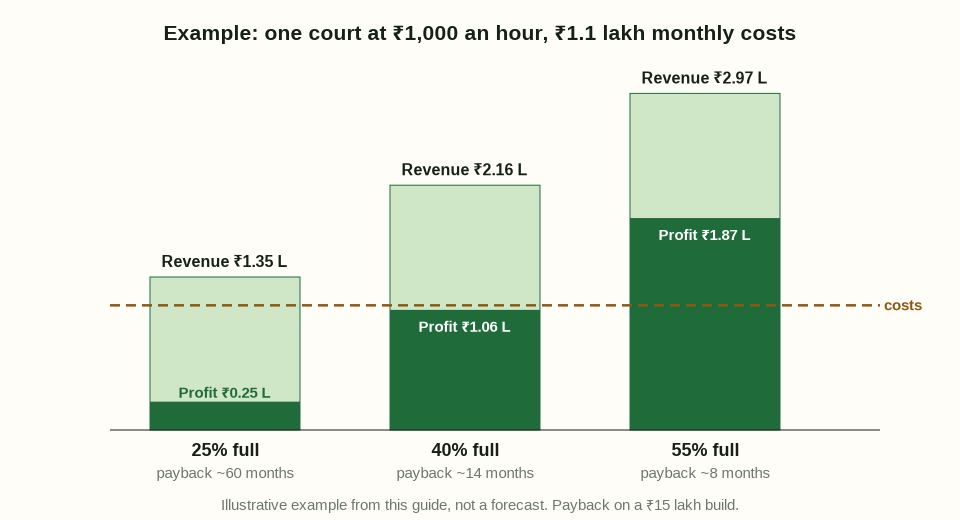
- One box cricket court, open 18 hours a day (6 am to midnight)
- Average price: ₹1,000 an hour (weekday mornings cheaper, evenings and weekends dearer)
- Build cost: ₹15 lakh on leased land
- Monthly running cost: rent ₹40,000 + electricity ₹20,000 + staff ₹30,000 + maintenance ₹10,000 + marketing and other ₹10,000 = ₹1,10,000
Now look at three levels of occupancy:
| Occupancy | Paid hours a day | Monthly revenue | Monthly profit | Payback on ₹15 lakh |
|---|---|---|---|---|
| 25% | 4.5 | 4.5 × ₹1,000 × 30 = ₹1,35,000 | ₹25,000 | about 60 months |
| 40% | 7.2 | 7.2 × ₹1,000 × 30 = ₹2,16,000 | ₹1,06,000 | about 14 months |
| 55% | 9.9 | 9.9 × ₹1,000 × 30 = ₹2,97,000 | ₹1,87,000 | about 8 months |
Payback is build cost divided by monthly profit, for example ₹15,00,000 ÷ ₹1,06,000 ≈ 14 months. This is before income tax and loan interest.
The turf profit margin is monthly profit divided by monthly revenue. In this example it is ₹25,000 ÷ ₹1,35,000 ≈ 19% at 25% occupancy, ₹1,06,000 ÷ ₹2,16,000 ≈ 49% at 40%, and ₹1,87,000 ÷ ₹2,97,000 ≈ 63% at 55%. The same sums work for football turf profit; only your price and costs change.
Two things stand out. First, the break-even point: ₹1,10,000 ÷ (₹1,000 × 30) ≈ 3.7 paid hours a day, or about 20% occupancy. Below that, you lose money every month. Second, every extra hour sold after break-even is almost pure profit, because your rent and staff costs don't change. Moving from 25% to 40% occupancy turns a weak business into a good one.
How long does payback take?
Published payback estimates differ, and it is worth knowing the spread:
- TurfBox says box cricket turfs break even in an average of 8 to 18 months (TurfBox), and puts ROI for a football turf at 12 to 24 months (TurfBox).
- A.S Sports and Infra gives a more cautious 1.5 to 3 years for a standard turf (A.S Sports and Infra).
Both builders and booking platforms have reasons to be optimistic, so plan on the cautious end and treat a faster payback as a bonus. Your own number comes from the worked example above, using quotes from builders in your area and the rent on your actual plot.
Why some turfs don't make money
Turfs rarely fail because the turf itself was bad. They fail because not enough hours were sold. The usual reasons:
- Location. A turf far from colleges, offices or dense housing struggles to fill weekday evenings. Players will not travel 40 minutes for an hour of cricket when there is a turf 10 minutes away.
- Too many turfs nearby. In some neighbourhoods several turfs have opened within a short distance. Prices fall and occupancy is split.
- Empty daytime hours. Most demand is in the evening and at weekends. If you have no plan for 6 am to 4 pm on weekdays, a large part of your hours earn nothing.
- High fixed costs. A high rent or a large loan raises your break-even occupancy. If you need 35% occupancy just to cover costs, a slow month hurts.
- Lost bookings. Players who message and get no reply for an hour book somewhere else. Missed calls, double bookings and confused payments all cost slots.
- Weak upkeep. Worn turf, broken nets and dim lights push regular teams to other venues.
How to raise occupancy
Occupancy is the number you can actually move after the turf is built. Practical steps:
- Price by time of day. Charge more for evenings and weekends and less for weekday mornings and afternoons. Our guide on how to price your turf per hour explains how to set peak and off-peak rates.
- Sell regular slots. A team that books every Tuesday at 8 pm for three months fills your calendar in advance. Offer a small discount for committing.
- Fill the daytime. Coaching for children, school and college games, corporate leagues, and lower off-peak prices all help.
- Run tournaments. A weekend tournament fills many hours at once and brings new teams who may come back as regulars.
- Make booking easy. Players should be able to see free slots and book in a minute, at any hour, without waiting for a call back.
- Stay visible. Keep a Google Business Profile with photos and correct hours, ask happy players for reviews, and post open slots on WhatsApp groups and Instagram. More ideas are in how to get more bookings for your box cricket turf.
How Turf Access helps
Turf Access is an online booking desk that helps you sell more of your hours. Each venue gets its own booking link, and players can also book through a shared WhatsApp number by picking a day, court, time and length. They pay the advance straight to your own UPI ID and tap Payment done (sharing the UTR is optional); you check it against your bank and confirm. A UTR already used on another booking is flagged.
From your phone you can see the day's board for every court, set peak, weekend and off-peak prices, and manage regular slots, memberships, coupons and tournaments. There is no commission: you buy prepaid credits, one per online booking, and walk-in and phone bookings you add are free. See how it works on our turf booking software page.
Frequently asked questions
Is turf business profitable in India?
It can be, if the turf fills enough paid hours every month. Rent, power and staff are mostly fixed, so profit depends on occupancy and price per hour more than on anything else. A turf in a weak location that sells only a few hours a day can struggle to cover its costs.
How much does a turf owner earn per month?
It varies widely with city, location and occupancy. Published estimates for monthly net profit run from under one lakh to a few lakh rupees for a single court. Work out your own figure with your price per hour, the hours you expect to sell and your actual monthly costs.
How long does it take to recover the investment in a turf?
Published estimates range from about 8 to 18 months at the optimistic end to 1.5 to 3 years at the cautious end. The real number depends on your build cost, whether you own or lease the land, and how quickly the turf fills up.
What is the profit margin of a turf business?
It depends almost entirely on occupancy. In our example of one court at ₹1,000 an hour with ₹1.1 lakh of monthly costs, the operating margin is about 19% at 25% occupancy, about 49% at 40% and about 63% at 55%. These are illustrative figures before income tax and loan interest, so redo the sum with your own costs and prices.
What occupancy does a turf need to break even?
Divide your monthly fixed costs by your average price per hour, then by 30 to get the paid hours you need each day. Compare that with the hours you are open. If you need more than a third of your hours booked just to cover costs, look again at rent, price or location.
Why do some turfs fail?
The common reasons are a poor location, too many turfs nearby, weak weekday and daytime bookings, and high rent or loan payments. Slow or confusing booking also loses players who would have booked if it were easy.