
Turf Business Plan in India: Template and Example
A turf business plan template for India: investment and monthly costs, pricing, occupancy, revenue model, risks and how to start, with a worked example.
A turf business plan is a short document that shows what you will build, what it will cost, how many hours you expect to sell, and when the money comes back. For a single turf in India it needs about ten sections: market, location, sports mix, one-time costs, monthly costs, pricing, occupancy, revenue model, marketing, licences and risks. Below is a section-by-section template, followed by a worked example you can redo with your own figures.
Use it for yourself, for a partner, or for a bank loan. Keep it short and honest. A plan that says "65% occupancy from month one" will not survive the first slow monsoon. The same template works as a box cricket business plan, since most turfs in India sell both box cricket and 5-a-side football.
If you want a turf business plan PDF to fill in, print this page or save it as a PDF from your browser's print menu, then write your own figures next to each section.
How to start a turf business: step by step
- Check demand near your site. List every turf within 3 to 5 km, with its sports, hourly rates and how full it looks in the evening.
- Pick the location and lease the land. Look for road access, nearby colleges, offices and housing, and a lease long enough to recover your investment.
- Decide the sports mix and court size. One court can be marked for both box cricket and 5-a-side football.
- Get itemised quotes. Fill in the one-time cost table below with real quotes for the base, grass, nets and lights.
- List your monthly costs and set prices. Rent, power, staff and upkeep, then peak and off-peak prices set against nearby turfs.
- Work out occupancy and payback. Show a slow, a likely and a good case, so you know how long your turf business investment takes to come back.
- Check licences and permissions. Business registration, land use, municipal permissions, the electricity connection and GST when your turnover needs it.
- Set up bookings and marketing before you open. A booking link, advance payments, a Google Business Profile and local WhatsApp groups.
The rest of this guide covers each step in detail.
Market, location and sports mix
Market: who will play and where they play now
Start with demand, not the turf.
- Who plays near your site? College students, office teams, residents of nearby apartments, school children for coaching.
- What do they play? Box cricket and 5-a-side football are the main turf sports. Pickleball and badminton are growing in many cities.
- Where do they play now? List every turf within 3 to 5 km: size, sports, hourly rates, and how full they look on a weekday evening and a weekend.
- What is missing? No turf with good lights nearby, no early-morning slots, no court big enough for 8-a-side.
Published hourly rates for turf and box cricket bookings run from about ₹800 to ₹2,000 (Franchise India). Your local rates matter more than any national range, so write down what nearby turfs actually charge.
Location and land
Location decides occupancy more than anything you build. Check:
- Distance from colleges, IT parks and dense housing (most players won't travel far for an hour's game)
- Road access, parking, and whether the area is safe late at night
- Lease length (long enough to recover your investment), rent and deposit
- Plot shape and usable size (see our guide to box cricket turf sizes for land per court)
- Land use rules for the plot, and whether neighbours will object to lights and noise late at night
Sports mix
Decide what each court will be used for. A single court can be marked for both box cricket and 5-a-side football. Write down the size of each court, the sports it supports, and the players per side. More sports widen your customer base but can mean extra equipment and markings.
Turf business plan costs: capex and opex
One-time costs (capex)
List every one-time cost with a quote. Ranges from published sources, for reference:
| Item | Range | Source |
|---|---|---|
| Base construction | ₹3–6 lakh | Gallant Sports |
| Artificial turf | ₹4–8 lakh | Gallant Sports |
| Fencing and netting | ₹2–4 lakh | Gallant Sports |
| Lighting | ₹2–5 lakh | Gallant Sports |
| Land or lease deposit | ₹2–5 lakh | Franchise India |
| Sports equipment | ₹50,000–₹1 lakh | Franchise India |
| Branding, launch and signage | ₹50,000–₹1 lakh | Franchise India |
| Initial working capital | ₹1–2 lakh | Franchise India |
Gallant Sports puts total startup investment at ₹12–25 lakh or more (Gallant Sports). Add washrooms, a small office, CCTV and a water connection if your plot doesn't have them. For a city-specific breakdown, see turf setup cost in Chennai.
Monthly costs (opex)
| Expense | Monthly range |
|---|---|
| Land rent | ₹30,000 – ₹80,000 |
| Electricity | ₹15,000 – ₹35,000 |
| Staff (2–3 people) | ₹25,000 – ₹50,000 |
| Turf maintenance | ₹5,000 – ₹15,000 |
| Marketing | ₹5,000 – ₹15,000 |
Source: TurfBox. Also include loan EMIs, water, internet, booking and payment costs, insurance, and a monthly reserve for repairs and the eventual replacement of the turf surface.
Pricing, occupancy and revenue model
Pricing
Set different prices for different times. Typical tiers:
- Peak: weekday evenings and weekends (highest price)
- Off-peak: weekday mornings and afternoons (lower price to attract groups)
- Late night: often in between
Write the price for each tier in your plan. Set each one against what nearby turfs charge for the same time.
Occupancy assumptions
Occupancy is the share of open hours that are paid for. Split it by tier, because evenings fill far more than afternoons. Be conservative for the first few months while word spreads, and show a slow, a likely and a good case. Banks and partners will trust a plan that shows what happens in the slow case.
Revenue model
Hourly bookings are the core of the turf business model. Add the other streams separately so you can see what each one contributes:
- Regular slots and memberships: teams that book the same slot every week, or players who pay monthly for a set number of games
- Tournaments: entry fees minus prizes and extra staff
- Coaching: a coach runs cricket or football classes in off-peak hours and shares the fee with you
- Corporate bookings: office teams on weekday evenings or weekend events
- Small extras: drinking water, snacks, equipment hire
Worked example: a one-court turf business plan
Example. Illustrative numbers only. Replace each with your own quotes, rents and prices.
Setup: one 80 × 40 ft court for box cricket and 5-a-side football, on leased land, open 18 hours a day (6 am to midnight).
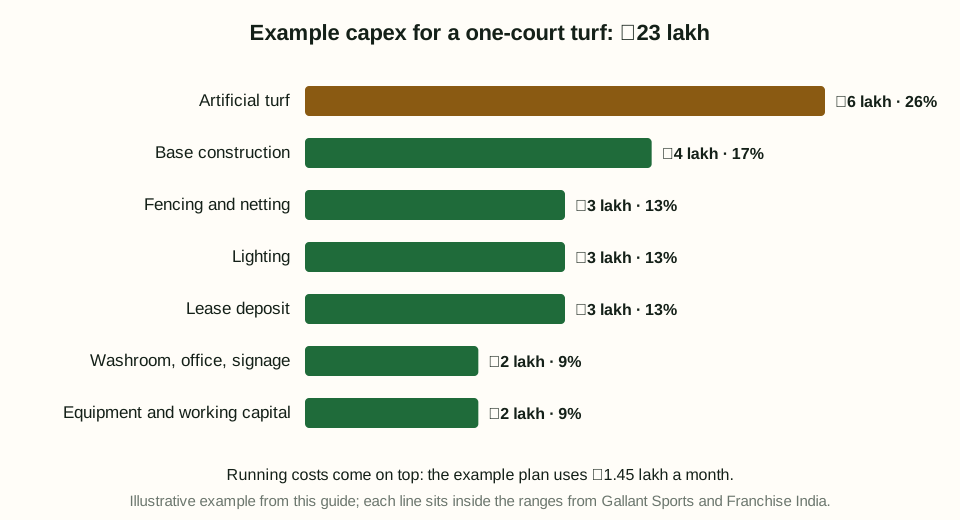
Capex (example, within the capex ranges above):
| Item | Amount |
|---|---|
| Base construction | ₹4,00,000 |
| Artificial turf | ₹6,00,000 |
| Fencing and netting | ₹3,00,000 |
| Lighting | ₹3,00,000 |
| Washroom, office, signage | ₹2,00,000 |
| Lease deposit | ₹3,00,000 |
| Equipment and working capital | ₹2,00,000 |
| Total | ₹23,00,000 |
Booking revenue (example, per day):
- Peak: 6 hours (6 pm to midnight) × 70% occupancy = 4.2 hours × ₹1,400 = ₹5,880
- Off-peak: 12 hours (6 am to 6 pm) × 20% occupancy = 2.4 hours × ₹800 = ₹1,920
- Daily total: ₹7,800. Monthly: ₹7,800 × 30 = ₹2,34,000
(For simplicity this treats weekends like weekdays. Higher weekend prices would add to it.)
Other revenue (example, per month):
- One tournament: 8 teams × ₹2,000 entry = ₹16,000, less ₹8,000 prizes = ₹8,000
- Coaching: 20 children × ₹1,500 = ₹30,000, half to the coach = ₹15,000
- Total other revenue: ₹23,000
Total monthly revenue: ₹2,34,000 + ₹23,000 = ₹2,57,000
Monthly costs (example): rent ₹50,000 + electricity ₹25,000 + staff ₹35,000 + maintenance ₹10,000 + marketing ₹10,000 + booking and payment costs ₹5,000 + repairs reserve ₹10,000 = ₹1,45,000
Monthly operating profit: ₹2,57,000 − ₹1,45,000 = ₹1,12,000
Payback: ₹23,00,000 ÷ ₹1,12,000 ≈ 20.5 months, before income tax and loan interest.
Now run the slow case. If off-peak occupancy stays at 10% and peak drops to 50%, booking revenue falls to (3 × ₹1,400 + 1.2 × ₹800) × 30 = ₹1,54,800 a month. With the same other revenue and costs, profit is ₹1,54,800 + ₹23,000 − ₹1,45,000 = ₹32,800, and payback stretches to about 70 months. That gap is why location and occupancy deserve the most space in your plan. We look at this in more detail in is turf business profitable in India.
Marketing, licences and risks
Marketing plan
- A Google Business Profile with photos, hours and the booking link
- Instagram and WhatsApp groups for open slots and tournament dates
- Launch offers for the first month and discounts for regular weekly slots
- Tie-ups with nearby colleges, offices and apartment associations
- Reviews from players after good games
Licences and permissions to check locally
Rules differ by state and city, so confirm the list with your local authority or a consultant. Items commonly listed include business registration, local municipal permissions, land use approval and an electricity connection (Gallant Sports). Also check:
- GST: service providers must register once aggregate turnover exceeds ₹20 lakh in normal category states (₹10 lakh in special category states) (ClearTax)
- Udyam (MSME) registration: free on the government's Udyam portal, and useful for some loans and schemes
- Trade licence, fire safety rules for any covered structure, signboard permission, and lighting or noise restrictions in residential areas
Risks and how you will handle them
| Risk | What to plan |
|---|---|
| Low weekday occupancy | Off-peak prices, coaching, corporate leagues |
| New turfs nearby | Regular-slot customers, upkeep, tournaments |
| Monsoon and summer heat | Drainage, roof options, indoor sports later |
| Landlord ends the lease | A long lease with a renewal clause |
| Turf wear | Monthly reserve for maintenance and replacement |
| Payment disputes and no-shows | Advance payment and a clear cancellation policy |
How Turf Access helps
Turf Access is an online booking desk that fits into the operations part of your plan. Each venue gets its own booking link, and players can also book through a shared WhatsApp number. They pay the advance straight to your own UPI ID and tap Payment done (sharing the UTR is optional); you check it against your bank and confirm.
From your phone you manage the day's board for every court, peak and off-peak prices, regular slots, memberships, coupons, tournaments and staff roles. There is no commission. You buy prepaid credits, one per online booking, and walk-in and phone bookings you add are free. Setup takes about five minutes. See our turf booking software.
Frequently asked questions
What should a turf business plan include?
It should cover the local market, the location, the sports you will offer, a one-time cost (capex) table, a monthly cost (opex) table, pricing, occupancy assumptions, revenue from bookings and other sources, marketing, licences and risks. The numbers should come from real quotes and local rents, not guesses.
How much investment is needed for a turf in India?
Published estimates for a single turf range from about ₹10 to 15 lakh for a small box cricket setup on rented land to ₹15 to 40 lakh or more for a larger turf, excluding land purchase. Your figure depends on size, materials, lighting and your city.
What is the business model of a turf?
A turf mainly earns by renting its court by the hour. Extra income can come from memberships and regular weekly slots, tournaments, coaching, corporate events and a small snacks counter. Profit depends on how many paid hours you sell against fairly fixed monthly costs.
How do I start a turf business in India?
Start by checking demand near your site and what nearby turfs charge. Then lease a well-located plot, decide the sports and court size, get itemised build quotes, list your monthly costs, set peak and off-peak prices and work out payback in a slow and a likely case. Check licences such as GST and local permissions, and set up bookings and advance payments before you open.
What licences are needed to start a turf in India?
Requirements vary by state and city. Commonly checked items include business registration, land use approval, local municipal permissions, a commercial electricity connection, and GST registration once turnover crosses the threshold. Confirm the exact list with your local authority or a consultant.
Is a bank loan available for a turf business?
Many owners finance part of the build with a business loan. Banks usually ask for a business plan with cost quotes and revenue projections, so a clear plan helps. Add the EMI to your monthly costs when you work out payback.