
Football Turf Size: 5, 7 and 9-a-Side in Feet and Sq Ft
Football turf size for 5, 7 and 9-a-side in feet, sq ft and metres, with goal sizes, run-off, net heights, land needed and which sizes book best.
Football turf size in India is usually about 80 × 50 ft (4,000 sq ft) for 5-a-side, 100 × 60 ft (6,000 sq ft) for 7-a-side and 120 × 80 ft (9,600 sq ft) for 9-a-side, according to Gallant Sports. Some builders recommend larger boxes, and official football guidance is larger again. Add a safety strip around the pitch and space for parking before you decide how much land you need.
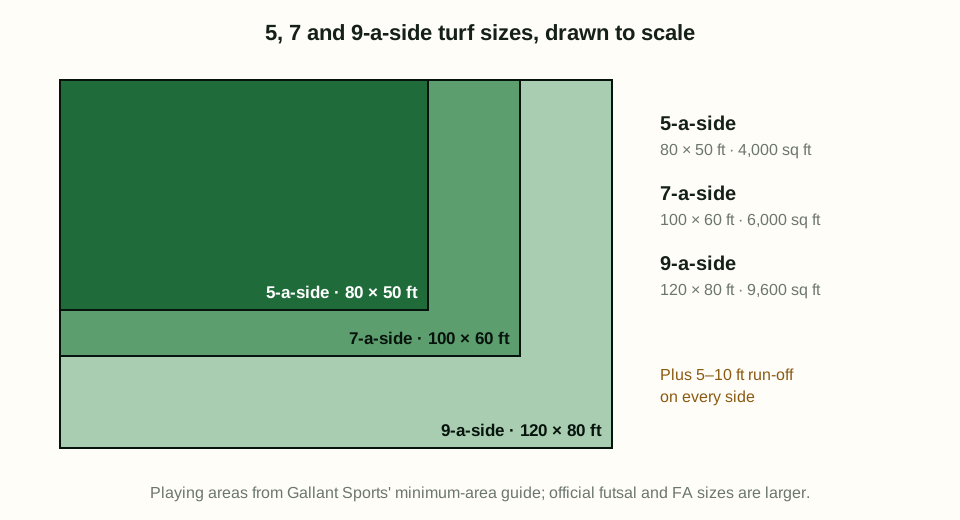
Below you will find the common sizes in feet, sq ft and metres, goal sizes, run-off, net and pole heights, the land to plan for, which sizes book best in Indian cities, and how to run box cricket and football on one turf.
Football turf size table: 5, 7 and 9-a-side
Sources do not agree on one "standard" size, because commercial turfs are built to fit the plot. Here are the two most common builder figures side by side. Metre values are converted and rounded.
| Format | Gallant Sports (ft) | Sq ft | Metres | Meckavo Sports (ft) | Sq ft |
|---|---|---|---|---|---|
| 5-a-side | 80 × 50 | 4,000 | 24.4 × 15.2 | about 98 × 66 | about 6,500 |
| 7-a-side | 100 × 60 | 6,000 | 30.5 × 18.3 | about 122 × 82 | about 10,000 |
| 9-a-side | 120 × 80 | 9,600 | 36.6 × 24.4 | not given | — |
Gallant's figures are from its minimum area guide. Meckavo's are from its guide on space needed for 5, 7 and 11-a-side turf.
If your plot allows, the larger size plays better. Players get room to pass and the game feels less like a scramble. If land is tight, the compact size still works for casual games, which is most of what city turfs sell.
How official guidance compares
Official sizes are bigger, and it helps to know them so you can explain your turf honestly to clubs and coaches.
| Format | Official reference | Metres | Feet (approx.) | Sq ft (approx.) |
|---|---|---|---|---|
| 5-a-side (futsal) | FIFA Futsal Laws of the Game, non-international | 25–42 × 16–25 | 82–138 × 52–82 | 4,300–11,300 |
| 5v5 youth | The FA pitch guide | 37 × 27 | 121 × 89 | 10,770 |
| 7v7 youth | The FA pitch guide | 55 × 37 | 180 × 121 | 21,780 |
| 9v9 youth | The FA pitch guide | 73 × 46 | 240 × 151 | 36,240 |
A typical 80 × 50 ft city turf sits just inside the futsal range. The FA youth sizes are for grass pitches and need far more land than most Indian city plots have.
Goal sizes for small-sided turfs
Match the goal to the pitch. A big goal on a short pitch makes every shot a goal; a tiny goal on a long pitch makes the game dull.
| Goal | Width × height | Source |
|---|---|---|
| Futsal | 3 × 2 m (about 10 × 6.5 ft) | FIFA Futsal Laws |
| 5v5 and 7v7 mini-soccer | 12 × 6 ft (3.66 × 1.83 m) | The FA |
| 9v9 youth | 16 × 7 ft (4.88 × 2.13 m) | The FA |
For a 5-a-side box of about 80 × 50 ft, futsal-size goals are a sensible fit. For a 7-a-side or 9-a-side turf, look at the FA sizes.
If the turf also hosts box cricket, choose goals that you can wheel away or fold against the net. Fixed goals get in the way of the batting crease.
Run-off, nets and pole heights
Run-off
The FA guide says the run-off around a pitch should be free of obstacles, with a minimum of 3 m and 4 m or more desirable for new pitches. Indian builders working with tight city plots usually suggest less: Gallant Sports advises 5–10 ft of space on all sides. On a fully netted turf, the net itself stops the ball, but players still need room to slow down before they hit a pole.
Net and pole heights
Most city turfs are fully netted on all sides and on top, especially if they also run box cricket. TurfBox recommends netting poles of 25–30 ft, and adds that a roof net needs 2–3 ft more height to allow for sagging. It also suggests a 3–5 ft buffer outside the nets for walkways and seating.
Checklist before you finalise heights:
- Will you run box cricket as well? Then plan full roof netting at cricket height.
- Is the turf next to homes, a road or a parking area? Higher side nets save you complaints.
- Are the poles outside the playing area, or padded if they are inside?
- Is there room for a gate on each side for players and a separate one for maintenance?
Land needed for a football turf
The playing area is only part of your land. Add the run-off, the netting buffer, and space for parking, toilets, a waiting area and a small office or counter.
TurfBox puts the minimum at about 3,500 sq ft for a compact setup, plus 1,500–2,000 sq ft for parking and amenities.
Example. Redo this with your own plan.
- 7-a-side playing area: 100 × 60 ft
- Add 10 ft on each side for run-off: (100 + 20) × (60 + 20) = 120 × 80 ft = 9,600 sq ft
- Add parking and amenities: 1,500–2,000 sq ft
- Total land: about 11,100–11,600 sq ft
Run the same sum for 5-a-side: (80 + 20) × (50 + 20) = 100 × 70 ft = 7,000 sq ft, plus parking and amenities, comes to about 8,500–9,000 sq ft.
Which football turf sizes book best in Indian cities
Meckavo Sports describes 5-a-side as the format with high rental demand in urban areas and the natural choice for owners setting up rental turfs (Meckavo). The reasons are practical:
- Easy to fill a team. A 5-a-side game needs 10 players; with substitutes, a group of 12–14 friends. A 7-a-side game needs 14 and a 9-a-side game needs 18. The smaller the group, the easier it is for someone to organise a booking after work.
- Cheaper per player. The hourly fee is split among fewer people, but the smaller box costs less to build and light, so you can price it lower.
- Dual use. A 5-a-side box can double as a box cricket turf, which widens your market on weekends.
- Land cost. In Chennai, Bengaluru, Hyderabad or Mumbai, land is the biggest cost. Two 5-a-side boxes on the same plot often earn more than one large pitch, because two groups can play at once.
7-a-side and 9-a-side turfs suit owners with more land, near colleges, corporate parks or academies, where coaching batches and leagues fill the slots. If you are unsure, ask the turfs near you which slots sell out first and for which format.
Combining box cricket and football on one turf
Many Indian turfs sell both sports on one surface. TurfBox describes an 80 × 50 ft box with 25 ft netting as excellent for cricket and 5-a-side football, and a 120 × 90 ft layout (10,800 sq ft) that can split into two box cricket fields or host a 7-a-side football game. Our guide on box cricket turf sizes covers the cricket side in detail.
To make the switch smooth:
- Use movable goals that store flat against the net.
- Mark football lines in one colour and the cricket crease in another.
- Price each sport separately if demand differs. Cricket groups often want longer slots than football groups.
- Keep the two-in-one turf as one court in your booking system, so a cricket booking and a football booking can never overlap.
How Turf Access helps
Whatever size you build, Turf Access can take your bookings. Each venue gets its own booking link and a shared WhatsApp booking number, where players pick the day, court, time and length. Football and box cricket in 5v5, 7v7 and 9v9 are among the 13 sports supported.
Players pay the advance straight to your UPI ID and tap Payment done; you check your UPI app and confirm. There is no commission. You can add each turf as a court, set peak, weekend and off-peak prices per court, and add walk-in and phone bookings for free. See how our turf booking software works; new venues get 20 free credits.
Frequently asked questions
What is the size of a 5-a-side football turf in feet?
Indian builders commonly quote about 80 × 50 ft (around 4,000 sq ft) for a compact 5-a-side turf, and some recommend closer to 98 × 66 ft (around 6,500 sq ft). The futsal laws allow a pitch of 25 to 42 m long and 16 to 25 m wide, which is roughly 82 to 138 ft by 52 to 82 ft.
What is the size of a 7-a-side football turf?
Commercial 7-a-side turfs in India are often quoted at about 100 × 60 ft (around 6,000 sq ft), while some builders suggest about 122 × 82 ft (around 10,000 sq ft). The FA's recommended 7v7 youth pitch is much larger at 55 × 37 m, so most city turfs are a compact version.
How much land do I need for a football turf?
Add a safety strip of 5 to 10 ft around the playing area, plus space for parking, a waiting area and toilets. One builder suggests at least 3,500 sq ft for a compact turf and another 1,500 to 2,000 sq ft for parking and amenities.
Can the same turf be used for football and box cricket?
Yes. Builders describe an 80 × 50 ft box with a 25 ft net as suitable for both box cricket and 5-a-side football, and a 120 × 90 ft layout that can split into two cricket boxes or host 7-a-side. You need full side and roof netting for cricket and removable or wall-mounted goals for football.
What size goal is used on a 5-a-side turf?
Futsal goals are 3 m wide and 2 m high, about 10 × 6.5 ft. The FA recommends 12 × 6 ft goals for 5v5 and 7v7 mini-soccer and 16 × 7 ft for 9v9. Pick a goal that fits your pitch length so shots stay fair.