
Padel Court Cost in India: Setup, Size and Payback
Padel court cost in India from ₹9 lakh to over ₹50 lakh: official court size, glass and turf, lights, roofing, land needed and a worked payback example.
Padel court cost in India ranges from about ₹9–14 lakh for a standard, installed court at the low end of published quotes to ₹25–45 lakh or more for a turnkey commercial court, and up to ₹55 lakh for an indoor panoramic court. The big swings come from three choices: standard or panoramic glass, open or covered, and how much civil work your site needs. Below, we break down the official court size, each cost item, the land you need, what venues charge per hour, and a worked payback example you can redo with your own numbers.
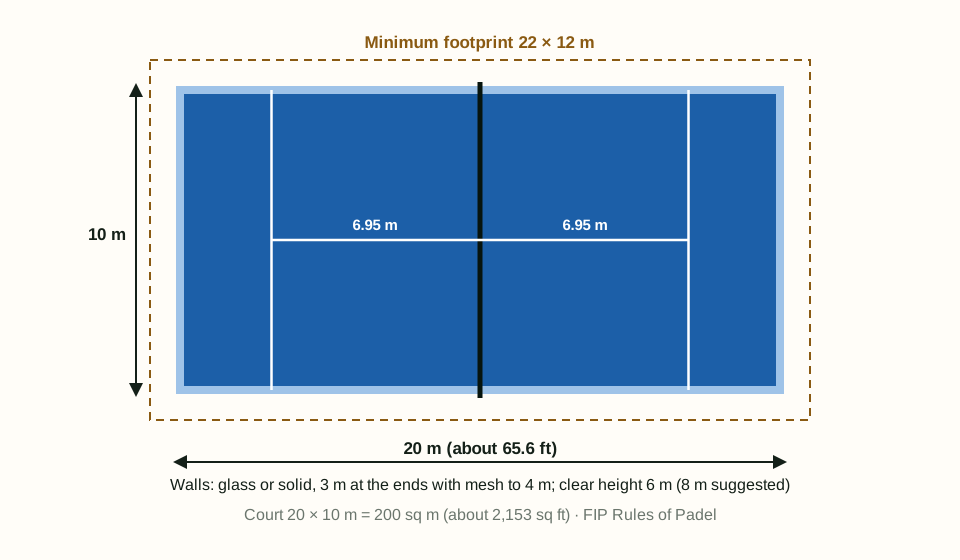
Official padel court size
The International Padel Federation (FIP) sets the court as a rectangle 10 metres wide by 20 metres long, measured inside, with a 0.5% tolerance (FIP Rules of Padel). That is 200 sq m, or about 2,153 sq ft of playing area.
The court is fully enclosed. The FIP rules describe:
- End walls 3 metres high, with metal mesh above them to a total height of 4 metres.
- Side walls that step down from the ends, finished with mesh. The rules allow two layouts: a stepped wall, or a "crystal" layout with a 3 m × 4 m glass section at each end and no step.
- Walls of glass, brick or other solid material, as long as the ball bounces evenly. Glass must be tempered safety glass.
- Net 0.88 m high at the centre and 0.92 m at the ends.
- Clear height of at least 6 metres over the whole court, with 8 metres suggested for new facilities. This matters if you plan a roof.
| Item | Size |
|---|---|
| Court (inside) | 20 m × 10 m (about 65.6 × 32.8 ft) |
| Playing area | 200 sq m (about 2,153 sq ft) |
| Wall + mesh height at ends | 4 m total (3 m wall + 1 m mesh) |
| Minimum clear height | 6 m (8 m suggested for new builds) |
Padel court cost in India: what builders quote
Published Indian quotes disagree a lot, mostly because they include different things. Here are three, side by side.
| Source | What's quoted | Range |
|---|---|---|
| Stark Sports | Standard court, fully installed | ₹9–14 lakh (midpoint ₹11–12 lakh) |
| ChampCourts | Outdoor, standard glass, turnkey | ₹25–32 lakh |
| ChampCourts | Outdoor, panoramic glass | ₹30–38 lakh |
| ChampCourts | Indoor / covered court | ₹38–45 lakh+ |
| Durosport | Standard outdoor, court only | ₹18–28 lakh |
| Durosport | Panoramic outdoor, court only | ₹28–42 lakh |
| Durosport | Indoor panoramic, court only | ₹35–55 lakh |
Read the fine print. Durosport says its figures cover the frame, glass and mesh, surface, net and standard LED lights, but not civil foundation work or roofing. ChampCourts quotes turnkey. Stark Sports says regional costs vary 15–25% across India, and tier-2 cities can save ₹1–2 lakh over metro pricing. When you collect quotes, ask each builder for a line-by-line list so you are comparing the same scope.
Standard vs panoramic courts
A standard court has steel posts between the glass panels. A panoramic court hides the frame so spectators get a clear view, which suits commercial clubs and events. ChampCourts says panoramic 12 mm glass adds roughly 15–25% to the overall cost, while Stark Sports puts the extra at ₹1–2 lakh over standard framing. Either way, panoramic is a choice for venues that expect to host tournaments or charge premium rates.
Cost breakdown: glass, turf, lights and base
Two builders' component lists show where the money goes. Again, the gap between them is large, so treat these as a checklist rather than a budget.
| Component | Stark Sports | ChampCourts (outdoor) |
|---|---|---|
| Steel structure | ₹2–4 lakh | ₹7–12 lakh |
| Glass (and mesh) | ₹2–3 lakh (glass) | ₹6–11 lakh (glass and mesh) |
| Turf / surface | ₹1.5–2.5 lakh | ₹4–8 lakh |
| Civil base and drainage | ₹2–3.3 lakh (base + drainage) | ₹4–7 lakh |
| LED lighting | ₹0.8–1.5 lakh | ₹2–4 lakh |
| Installation and labour | ₹0.7–1.2 lakh | Included |
| Roof (covered courts) | Not included | ₹8–15 lakh |
A few notes on each item:
- Glass and mesh. Regulation courts use 10 mm or 12 mm tempered glass. Thicker glass and panoramic framing cost more but feel and look better.
- Turf. Padel turf is a specific sand-filled synthetic surface, not football turf. ChampCourts recommends monofilament turf with silica infill and warns that cheaper surfaces need early replacement.
- Lights. ChampCourts notes that proper LED floodlighting can stretch usable hours from about 6 to 12 a day. Evening hours are often your best sellers, so don't cut corners here.
- Civil base. A level concrete base with good drainage is essential. Sloping or soft soil adds excavation and foundation cost.
Roofing for Indian weather
In much of India, a roof is the biggest single decision after the court itself. Summer afternoons are hard to sell on an open court, and monsoon rain can shut you down for days at a time. ChampCourts calls the indoor decision "the single largest lever" on cost and says a covered court adds ₹8–15 lakh for the structure and a 6 m clear height.
Remember the FIP height rule: at least 6 m of clear space over the court, and 8 m suggested for new facilities. A low shed roof will not work for padel; your fabricator needs to plan for the height from day one.
If you build open-air, plan for the monsoon. Stark Sports lists post-monsoon sand redistribution and drainage clearance as part of regular upkeep (Stark Sports). Good slope and drains under the turf will save you lost days.
Land needed for a padel court
The court is 200 sq m, but you need more ground than that. Stark Sports gives a minimum clear footprint of 22 × 12 m for a playable court, and recommends 23 × 13 m so players have room to chase the ball (Stark Sports).
| Plan | Size | Area |
|---|---|---|
| Court only | 20 × 10 m | 200 sq m (about 2,153 sq ft) |
| Minimum footprint | 22 × 12 m | 264 sq m (about 2,840 sq ft) |
| Comfortable footprint | 23 × 13 m | 299 sq m (about 3,220 sq ft) |
On top of that, add space for parking, a small seating area, washrooms and a counter. If you already run a box cricket or football turf, check whether a corner of your plot can take a 23 × 13 m footprint. Our pickleball court cost guide covers a smaller racket sport that fits tighter plots.
What padel courts charge per hour
Rates vary widely by city, area and time of day. Durosport puts typical metro rates at ₹600–1,800 per court per hour in cities such as Bengaluru, Mumbai and Hyderabad (Durosport). In Mumbai, Time Out lists clubs charging ₹1,250–3,000 an hour depending on location, and one Worli club at ₹3,500–4,000 an hour for up to four players (Time Out Mumbai).
For Chennai and smaller cities, look up the venues nearest your site on booking apps and note their weekday, evening and weekend rates. Your rate should sit within what players near you already pay. Our guide on how to price your turf per hour shows how to set peak and off-peak rates.
Worked example: padel court payback
Example only. Replace every number with your own quotes, rent and local rates.
Assumptions:
- Build cost: ₹30 lakh (an outdoor court within the published ranges above)
- Hourly rate: ₹1,200 (within Durosport's metro range)
- Booked hours: 6 a day on average
- Monthly running costs (rent, power, staff, upkeep): ₹70,000
Arithmetic:
- Monthly revenue = 6 hours × ₹1,200 × 30 days = ₹2,16,000
- Monthly surplus = ₹2,16,000 − ₹70,000 = ₹1,46,000
- Payback = ₹30,00,000 ÷ ₹1,46,000 ≈ 20.5 months
Now a slower case with only 4 booked hours a day:
- Monthly revenue = 4 × ₹1,200 × 30 = ₹1,44,000
- Monthly surplus = ₹1,44,000 − ₹70,000 = ₹74,000
- Payback = ₹30,00,000 ÷ ₹74,000 ≈ 40.5 months
Two booked hours a day nearly doubles the payback time. For comparison, Durosport estimates a payback of 24–40 months on a ₹30 lakh court in a tier-1 city, assuming 50–65% occupancy. The lesson: booked hours matter more than almost anything else. For a wider look at the numbers, read is a turf business profitable in India.
How Turf Access helps
Once your padel court is built, every unsold hour hurts the payback. Turf Access gives your venue a booking link (turfaccess.com/book/your-venue) and booking through a shared WhatsApp number, with padel as one of 13 supported sports. Players pay the advance straight to your own UPI ID; there is no commission and Turf Access never holds player money.
From your phone you see the day's board for every court, set peak, weekend and off-peak prices, and run regular slots, memberships, coupons and tournaments. You pay with prepaid credits, one per online booking, and walk-ins you add are free. Setup takes about five minutes. See the turf booking software.
Frequently asked questions
How much does it cost to build a padel court in India?
Published Indian builder estimates range widely, from about ₹9 to 14 lakh for a standard installed court at one builder to ₹25 to 45 lakh turnkey at another, and up to ₹55 lakh for an indoor panoramic court. The gap comes from what each quote includes, such as civil work, glass type and a roof. Always compare quotes line by line.
What is the size of a padel court?
The International Padel Federation sets the court at 20 metres long and 10 metres wide, measured inside, which is 200 square metres or about 2,153 sq ft. The ends are enclosed by 3 metre walls with mesh above, up to a total height of 4 metres.
How much land do I need for one padel court?
Plan for more than the 200 square metre court itself. One Indian builder gives a minimum clear footprint of 22 × 12 metres, about 2,840 sq ft, and recommends 23 × 13 metres, about 3,220 sq ft, so players have room around the court. Add space for parking, a seating area and washrooms.
What do padel courts charge per hour in India?
Rates vary a lot by city and venue. One Indian builder puts metro rates at ₹600 to ₹1,800 per court per hour, while some Mumbai clubs charge ₹1,250 to ₹4,000 an hour at peak. Check venues near your site before you set your own price.
Is a padel court business profitable in India?
It can be, but it depends on your build cost, rent and how many hours you sell each day. A simple way to check is to multiply your expected booked hours by your hourly rate, subtract monthly running costs, and divide the build cost by what is left to get the payback period in months.