
Padel Court Size in Feet: Dimensions, Walls and Land
Padel court size in feet: about 65.6 × 32.8 ft (20 × 10 m), or 2,153 sq ft. Wall heights, service lines, ceiling height and land for one to three courts.
The padel court size in feet is about 65.6 ft long by 32.8 ft wide, which is the official 20 × 10 metre doubles court measured inside the walls (International Padel Federation). That works out to roughly 2,153 sq ft of playing area. But you need more land than that: the walls, a clear zone around the court and a tall roof if you build indoors all add to the space. Below are the full padel court dimensions, wall heights, service lines, net height, singles size, and how much land to keep for one, two or three courts.
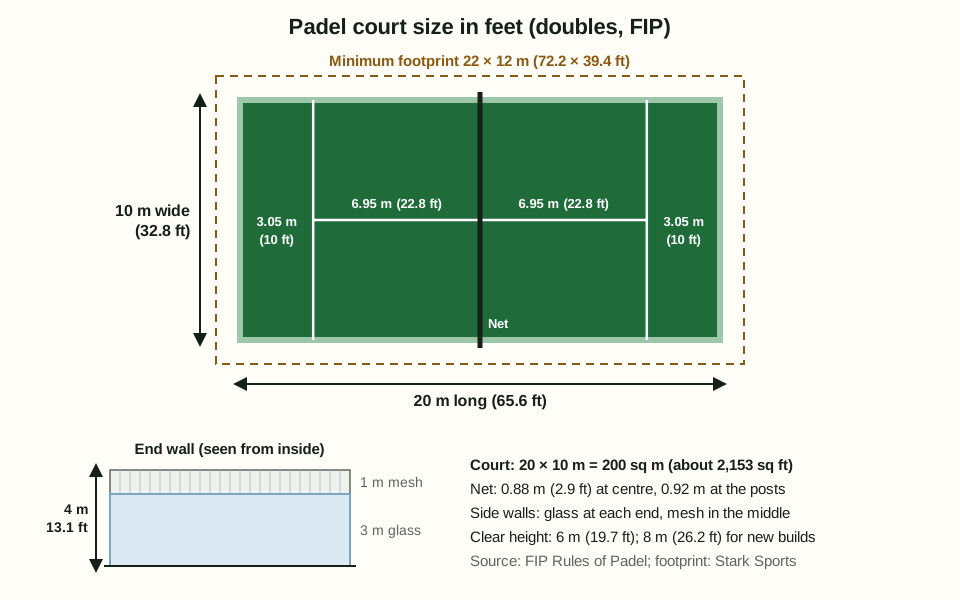
Padel court size in feet and sq ft
The International Padel Federation (FIP) sets the court as a rectangle 10 metres wide by 20 metres long, measured from the inside, with a 0.5% tolerance (FIP Rules of Padel). Every padel court measurement in this post is converted from those metres, using 1 metre = 3.28 ft.
| Measurement | Metres | Feet |
|---|---|---|
| Length (inside) | 20 m | about 65.6 ft |
| Width (inside) | 10 m | about 32.8 ft |
| Playing area | 200 sq m | about 2,153 sq ft |
| Service line from the net | 6.95 m | about 22.8 ft |
| Service line to back wall | 3.05 m | about 10 ft |
| Line width | 5 cm | about 2 inches |
The 0.5% tolerance is small: on a 20 metre length it is just 10 cm. Ask your builder to measure inside the glass with you before the final payment.
Court markings, service lines and net height
Padel has very few lines. The FIP rules describe only three kinds (FIP Rules of Padel):
- Service lines, one on each side, parallel to the net and 6.95 m (about 22.8 ft) from it.
- A central service line that splits the area between the net and each service line in half, so there are two service boxes on each side. It runs at least 20 cm beyond the service line.
- Line colour and width: all lines are 5 cm wide, preferably white or black so they stand out from the surface. There are no side lines or baselines; the walls are the boundary.
The net is 10 m long, 0.88 m (about 2.9 ft) high at the centre and 0.92 m (about 3 ft) at the ends. The posts at each side can be no taller than 1.05 m.
Walls and mesh: how high the enclosure goes
A padel court is fully enclosed, and the walls are part of play. Here is what the FIP rules ask for (FIP Rules of Padel):
| Part | What the rules say | In feet |
|---|---|---|
| End walls (back walls) | 3 m of wall, then 1 m of metal mesh, 4 m total | about 9.8 ft wall, 13.1 ft total |
| Side walls, stepped layout | A 3 m high × 2 m long step, then a 2 m high × 2 m long step, at both ends, with mesh above | 9.8 ft and 6.6 ft steps |
| Side walls, "crystal" layout | A 3 m high × 4 m long wall at each end, no step, with mesh above | 9.8 ft high, 13.1 ft long |
| Mesh at the far ends | Mesh completes the enclosure up to 4 m | about 13.1 ft |
| Court access | One opening per side at least 1.05 × 2.0 m, or two openings per side at least 0.72 × 2.0 m | about 3.4 × 6.6 ft (one opening) |
The walls can be glass, brick or another solid material, as long as the ball bounces evenly and the surface is hard and smooth. Glass must meet tempered or safety glass standards. Most commercial courts in India use glass so that people outside can watch. Ask your builder which side-wall layout they are quoting.
Ceiling height for an indoor padel court
This is where many indoor plans go wrong. Lobs are part of the game, so the FIP rules ask for a minimum clear height of 6 m (about 19.7 ft) over the whole court, with nothing such as lights hanging into that space. For new facilities, the rules suggest 8 m (about 26.2 ft) (FIP Rules of Padel).
What that means when you plan a shed:
- Measure to the lowest point. The 6 m is to the bottom of trusses, purlins, fans and light fittings, not to the roof sheet.
- Lights go on the side. Mount floodlights on the side of the structure or above the clear height, so they don't eat into the space.
- Ask for 8 m if you can. It costs more steel, but players notice a low roof straight away, and you cannot raise it later.
ChampCourts, an Indian court builder, says a covered court adds ₹8–15 lakh or more for the structure and is the main way to keep selling hours through the monsoon (ChampCourts). For the full cost picture, see our guide to padel court cost in India.
Roof or open air: Chennai heat and rain
In Chennai and the rest of Tamil Nadu, the hard months are not only the summer. October to December is the chief rainy season for Tamil Nadu, bringing about 48% of its annual rainfall, and it is also the main cyclone season for the region (India Meteorological Department). An open court can lose many evenings in a row in those months.
A few practical points if you are deciding:
- Open court. Cheaper to build. Slope the base for drainage and plan for down days in the rains. Afternoons in April to June are hard to sell, so most bookings will come early morning and after sunset.
- Roof with open sides. Keeps rain and sun off while letting air move. Make sure driving rain from the side doesn't wet the turf near the walls.
- Fully enclosed hall. Best for year-round play, but needs good ventilation and lighting. Glass walls and a closed hall can trap heat.
Stark Sports also notes that standard club courts face north–south, with up to about 15 degrees of tolerance, to keep low sun out of players' eyes (Stark Sports). This matters most on open courts.
Singles padel court size
A singles padel court keeps the 20 m length but is only 6 m wide, giving 120 sq m (Padel 247). In feet, that is about 65.6 × 19.7 ft, or roughly 1,292 sq ft. Singles courts are used in small clubs, for coaching and where space is limited. Official competition uses the 20 × 10 m doubles court, so if you plan to host tournaments, build doubles.
| Court | Metres | Feet | Area |
|---|---|---|---|
| Doubles (official) | 20 × 10 m | 65.6 × 32.8 ft | about 2,153 sq ft |
| Singles | 20 × 6 m | 65.6 × 19.7 ft | about 1,292 sq ft |
Padel court area required: land for one, two or three courts
The court is 200 sq m, but the frame, walls and a walkway around them need more. Stark Sports, an Indian builder, gives a minimum clear footprint of 22 × 12 m for one court, which is 1 m behind each back wall and 1 m on each side, and a more comfortable 23 × 13 m with 1.5 m margins (Stark Sports). For two courts side by side, it suggests about 22 × 26 m, with at least a 2 m gap between the courts (Stark Sports).
| Plan | Metres | Feet | Area |
|---|---|---|---|
| 1 court, minimum | 22 × 12 m | 72.2 × 39.4 ft | about 2,842 sq ft |
| 1 court, comfortable | 23 × 13 m | 75.5 × 42.7 ft | about 3,218 sq ft |
| 2 courts side by side | 22 × 26 m | 72.2 × 85.3 ft | about 6,157 sq ft |
These figures are for the courts only. Add parking, a reception counter, seating, washrooms and a changing area.
Example: land for three courts
Example only. Redo this with your builder's exact frame sizes.
Three courts side by side, using the same spacing as the two-court layout above (2 m at each outer side and 2 m between courts):
- Width = 3 courts × 10 m + 2 gaps × 2 m + 2 edges × 2 m = 30 + 4 + 4 = 38 m
- Length = 20 m + 1 m at each end = 22 m
- Area = 38 × 22 = 836 sq m, about 9,000 sq ft (124.7 × 72.2 ft)
If you want out-of-court play
Advanced players sometimes run outside the court through the side openings to return a ball. The FIP rules allow this only if each side has two openings and there is a clear zone outside of at least 3 m wide (4 m recommended), 4 m long on either side and 3 m high (FIP Rules of Padel). That is about 9.8–13.1 ft of extra width on each side, so it changes your land plan a lot. Decide on it before you finalise the layout.
If you already run a cricket or football turf, compare these sizes with our box cricket turf size guide to see whether a padel court fits beside it.
What to check before you build
Use this list when you visit a plot or meet builders:
- Clear land. At least 22 × 12 m per court for the court and walkway, plus room for parking and facilities.
- Level, firm ground. The FIP rules want the finished surface within 3 mm over a 3 m straight edge (FIP Rules of Padel), so the concrete base needs to be very flat. Check for soft soil and water logging.
- Drainage. Where water goes during heavy rain, especially for an open court in the October to December rains.
- Height for a roof. 6 m clear minimum, 8 m suggested, to the lowest point of the structure and lights.
- Orientation. A north–south long axis for open courts, if the plot allows.
- Wall layout. Stepped or crystal side walls, glass thickness, and whether the quote is "court only" or includes civil work and roof.
- Access and safety. Court openings to FIP size, padding on the access edges and net posts, and space for players to walk between courts.
- Neighbours. Stark Sports suggests courts at least 20 m from residential windows are generally unproblematic for noise (Stark Sports). Closer than that, plan screening and earlier closing times.
How Turf Access helps
Once your padel court is up, Turf Access helps you fill it. Padel is one of 13 sports it supports. Your venue gets its own booking link (turfaccess.com/book/your-venue) and booking through a shared WhatsApp number. Players pay the advance straight to your UPI ID, there is no commission, and Turf Access never holds player money.
On your phone you see the day's board for every court, set peak, weekend and off-peak prices, and add walk-ins and phone bookings for free. Online bookings use prepaid credits, one per booking, and new venues get 20 free credits. Setup takes about five minutes. See the turf booking software.
Frequently asked questions
What is the padel court size in feet?
A doubles padel court is 20 metres long and 10 metres wide, measured inside the walls, under the International Padel Federation rules. That is about 65.6 ft long and 32.8 ft wide, or roughly 2,153 sq ft of playing area.
How much land is required for one padel court?
The court itself is about 2,153 sq ft, but you need room around it. One Indian builder gives a minimum clear footprint of 22 × 12 metres, about 2,842 sq ft, and recommends 23 × 13 metres, about 3,218 sq ft. Add parking, a seating area and washrooms on top of that.
How high should the roof be for an indoor padel court?
The International Padel Federation asks for at least 6 metres, about 19.7 ft, of clear height over the whole court, with nothing such as lights hanging into that space. For new facilities it suggests 8 metres, about 26.2 ft. Plan this height before you order the shed, because a low roof cannot be fixed later.
What is the size of a singles padel court?
A singles padel court keeps the 20 metre length but is only 6 metres wide, which is about 65.6 × 19.7 ft or 1,292 sq ft. Singles courts are less common and are mostly used for training or where space is tight. Official competition uses the 20 × 10 metre doubles court.
How high is the net and where are the service lines on a padel court?
The net is 0.88 metres high at the centre, about 2.9 ft, rising to 0.92 metres at the posts. The service lines run parallel to the net 6.95 metres, about 22.8 ft, from it on each side, leaving 3.05 metres, about 10 ft, between each service line and the back wall.