
Turf Maintenance Cost: Monthly Budget and Checklist
Turf maintenance cost in India: what to budget each month, infill top-up and brushing costs, a daily to yearly checklist, monsoon care and saving for new grass.
Turf maintenance cost for a single artificial turf in India is commonly estimated at about ₹5,000 to ₹15,000 a month for brushing, cleaning and infill (TurfBox). That covers routine care only. You also need to budget for net and light repairs, the power bill, staff time and, most importantly, a monthly reserve for replacing the grass after 5 to 10 years.
This guide lists what an artificial turf actually needs, gives a daily to yearly checklist, shows the costs we could find in public sources, and works through how much to save each month for new grass.
What turf maintenance cost covers
Artificial turf is low maintenance, not no maintenance. FIFA's maintenance guide for football turf calls the idea of a maintenance-free surface a myth, and warns that a neglected field loses its looks, its safety, its playing quality and years of its life (FIFA Quality Concept for Football Turf).
The work falls into a few groups:
- Brushing. Lifts the fibres so they don't lie flat and spreads the infill evenly.
- Infill top-up. Puts back the sand and rubber granules that get kicked out, washed away or compacted.
- Cleaning. Removes leaves, wrappers, chewing gum, bird droppings and dust before they clog the surface.
- Seams and lines. Open seams are a tripping hazard. Lines fade and come loose at the edges.
- Nets and poles. Box cricket nets take hits every day and weather in the sun and rain.
- Floodlights and power. Lights that fail or dim make your evening slots, your best-selling hours, hard to sell.
Published estimates for routine maintenance vary. TurfBox puts turf maintenance and cleaning at ₹5,000 to ₹15,000 a month for a football turf in one guide (TurfBox), and suggests setting aside ₹4,000 to ₹10,000 a month in another (TurfBox). Both are for a single court. Your figure depends on the turf area, how many hours are played, and whether your own staff do the work or you pay a maintenance contractor.
Turf maintenance checklist: daily to yearly
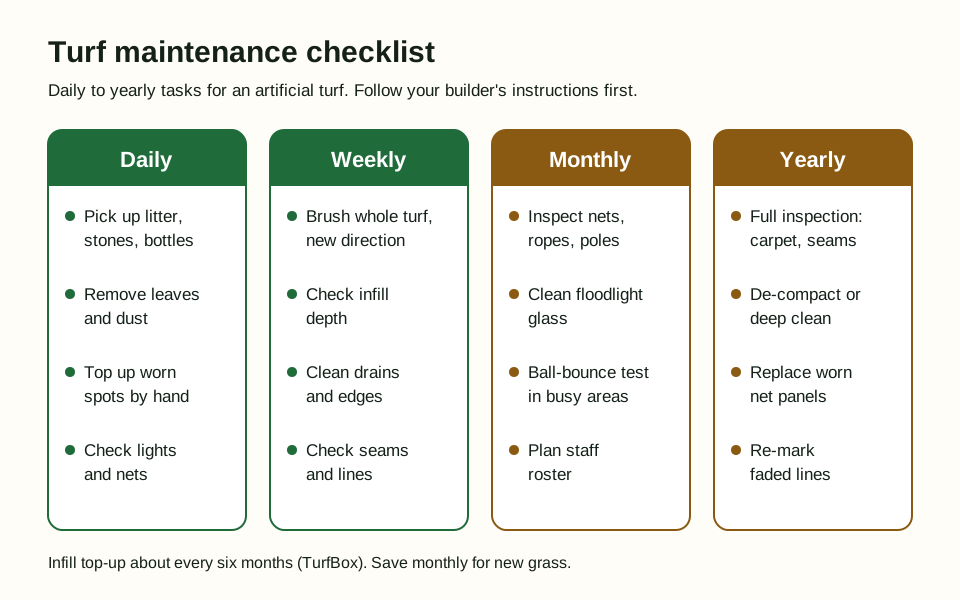
Your builder's maintenance instructions come first. Warranties are usually linked to following them, and FIFA's guide says incorrect or missing maintenance can void the warranty (FIFA Quality Concept for Football Turf). Use the list below as a starting point and adjust it to your turf.
Daily
- Walk the turf before the first slot. Pick up bottles, wrappers, stones and anything sharp.
- Remove leaves and dust. FIFA's guide notes that in the most vulnerable periods the pitch should be cleaned daily, because organic material mixes with the infill and leads to a harder surface, poorer drainage and moss or algae (FIFA Quality Concept for Football Turf).
- Top up heavy-wear spots by hand: the batting crease, bowling run-up, goalmouths and corners.
- Check that every light comes on and that no net is torn at player height.
- Keep food, chewing gum and smoking off the turf.
Weekly
- Brush the whole turf, changing direction each time so the fibres don't lean one way (FIFA Quality Concept for Football Turf).
- Check infill depth at a few marked spots. FIFA's guide recommends weekly checks of fill levels (FIFA Quality Concept for Football Turf).
- Clean the drains and the turf edges, where infill and dirt collect.
- Look for loose seams, lifted lines and net ties that have come undone.
Monthly
- Inspect nets, ropes and pole bases for rust and wear.
- Clean the floodlight glass and check fittings and wiring.
- Bounce a ball in busy areas. Uneven bounce can mean the infill has compacted or thinned (FIFA Quality Concept for Football Turf).
Yearly
- Get a full inspection of the carpet, seams, lines and infill height. Sport England's guidance lists an annual inspection and condition report, along with drag brushing every two weeks and de-compaction twice a year (Sport England).
- Book a deep clean or de-compaction before the monsoon if the surface feels hard.
- Replace worn net panels and re-mark faded lines.
Turf infill top up: what it costs
Infill is usually silica sand plus SBR rubber granules. It slowly leaves the turf on shoes and clothes, gets kicked to the edges and is washed away in heavy rain. Low infill makes the fibres bend and wear out faster.
TurfBox suggests refilling SBR rubber granules and silica sand about every six months to keep the cushioning (TurfBox). Busy turfs may need small daily top-ups in high-wear spots.
| Item | Published price | Source |
|---|---|---|
| SBR rubber granules | about ₹23–30 per kg | Supplier listings on IndiaMART |
| Infill (sand and granules) at build | ₹8–15 per sq ft | Champ Courts |
Prices vary by supplier, grade and quantity, and some suppliers sell only in large minimum orders. FIFA's guide suggests buying spare infill when the turf is laid, so the same material is always on hand (FIFA Quality Concept for Football Turf).
Example. Say your top-up needs 200 kg of rubber granules. At ₹23 to ₹30 per kg, that is 200 × ₹23 = ₹4,600 to 200 × ₹30 = ₹6,000, plus sand and labour. Ask your builder how many kg your turf needs per top-up and redo the sum.
Brushing equipment and staff time
Small turfs are often brushed by hand with a stiff broom or a drag brush pulled across the surface. Larger turfs, or owners who want to save staff time, buy a power brush.
| Equipment | Published price | Source |
|---|---|---|
| Power brushing machine for artificial turf | about ₹45,000–56,000 | Supplier listings on IndiaMART |
FIFA's guide says to brush when the surface is dry and to use only brushes your turf manufacturer recommends (FIFA Quality Concept for Football Turf).
Most of the cost of artificial turf maintenance is staff time, not materials. The same ground staff who open the gate and check bookings usually do the daily sweep and top-up. Plan the work into quiet hours, such as early afternoon on weekdays, so it never blocks a paid slot.
Example. If the daily walk and spot top-up take 30 minutes and the weekly brush takes 2 hours, that is about 15 + 8 = 23 hours a month. Write it into a staff roster so it actually happens.
Nets, poles and floodlights
Nets wear faster than anything else in a box cricket turf. TurfBox says good UV-resistant HDPE nets last 3 to 5 years before needing partial replacement, and treated GI poles can last 15 to 20 years if protected from rust (TurfBox). Tie up small tears early, before they spread.
Floodlights are mostly a power cost. Electricity for a football turf is estimated at ₹15,000 to ₹35,000 a month (TurfBox). Clean fittings give more light for the same bill. Our turf setup cost in Chennai guide shows how to estimate your power bill from the Tamil Nadu tariff.
Monsoon and summer care in Chennai
Tamil Nadu gets about 48% of its annual rainfall in the October to December northeast monsoon (IMD Chennai). Rain often comes in heavy spells, which is hard on a turf:
- Infill washes to the low side and the edges. After heavy rain, check infill levels, as FIFA's guide advises, and brush it back (FIFA Quality Concept for Football Turf).
- Blocked drains leave standing water and cost you playing hours. Clear drains before the monsoon and after every big storm.
- Wet leaves and mud feed moss and algae. Remove them quickly. Use only chemicals your supplier approves (FIFA Quality Concept for Football Turf).
- Brush only once the surface is dry.
Summer brings the opposite problem. FIFA's guide notes that turf heats up in warm weather and that watering cools the surface and helps keep infill in place (FIFA Quality Concept for Football Turf). In a Chennai April or May, a light watering before afternoon slots makes play more comfortable.
Artificial turf replacement cost and how to save for it
The biggest maintenance cost is the one you pay once every several years: new grass. Published lifespans vary:
| Source | Expected life |
|---|---|
| TurfBox | 7–10 years for quality football turf; 4–5 years for lower grades |
| Champ Courts | about 8–10 years of heavy use |
| CCGrass | 10–15 years for high-quality grass; warranties of 8–12 years |
The longer figures assume good maintenance and moderate use. A busy box cricket turf open 18 hours a day wears faster, so plan on the shorter end.
Replacement grass is priced per sq ft. Artificial grass alone is commonly quoted at ₹60 to ₹120 per sq ft (KheloMore), and infill at ₹8 to ₹15 per sq ft (Champ Courts). Add labour and removing the old carpet, which your builder must quote.
For a sense of scale, Sport England's life cycle guidance for football artificial pitches sets aside 2.6% to 2.9% of the total project cost each year as a sinking fund for replacing the carpet, lights and fencing, plus 0.4% to 0.5% for maintenance (Sport England). Those are UK figures, but the idea holds: save a fixed amount every month.
Example. A 3,200 sq ft box cricket turf.
| Item | Working | Amount |
|---|---|---|
| Grass | 3,200 sq ft × ₹90 | ₹2,88,000 |
| Infill | 3,200 sq ft × ₹12 | ₹38,400 |
| Labour and removal (your builder's quote) | assumed | ₹50,000 |
| Replacement cost | ₹3,76,400 |
Monthly reserve = replacement cost ÷ months of life.
- If the grass lasts 7 years: ₹3,76,400 ÷ 84 months ≈ ₹4,480 a month.
- If it lasts 5 years: ₹3,76,400 ÷ 60 months ≈ ₹6,270 a month.
Put this amount in a separate account every month. When the grass is worn, the money is there and you don't need a new loan.
How good upkeep keeps bookings and prices up
Players notice the surface the moment they step on it. Flat, hard grass, torn nets and a dim corner send regular teams to the turf down the road. A well-kept turf lets you hold your evening and weekend rates instead of discounting to fill slots. Our guide on how to price your turf per hour explains peak and off-peak pricing.
Good upkeep also protects your payback period. Every year you add to the life of the grass is a year without a replacement bill. The numbers in is a turf business profitable in India show how much a few extra paid hours a day matter; worn turf quietly takes those hours away.
How Turf Access helps
Turf Access is an online booking desk for sports venues. From the owner desk on your phone you see the day's board for every court, so you can spot the quiet hours to schedule brushing and infill top-ups without blocking a paid slot. You can add walk-in and phone bookings for free, set peak, weekend and off-peak prices per court, and manage regular slots and memberships.
Players book through your own booking link or a shared WhatsApp number and pay the advance straight to your UPI ID. There is no commission; you buy prepaid credits, one per online booking. See how it works on our turf booking software page.
Frequently asked questions
What is the monthly maintenance cost of an artificial turf in India?
Published estimates for a single turf run from about ₹4,000 to ₹15,000 a month for brushing, cleaning and infill. That does not include electricity, staff salaries or a reserve for replacing the grass, which you should budget for separately.
How often should turf infill be topped up?
Check infill levels every week, especially in the goal areas, batting crease and corners where play is heaviest. One Indian builder suggests refilling rubber granules and sand about every six months; busy turfs and turfs that lose infill in heavy rain may need small top-ups more often.
How long does artificial turf last?
Quality football turf is commonly quoted to last about 7 to 10 years with proper maintenance, and lower-grade turf may need replacing after 4 to 5 years. Heavy daily use, poor brushing and low infill all shorten its life.
How much does it cost to replace artificial turf?
Work it out from the area: the grass per sq ft plus infill per sq ft, multiplied by your turf area, plus labour and removal of the old carpet. Ask your builder for a written replacement quote and divide it by the months of life you expect, so you can save a fixed amount every month.
Does artificial turf need maintenance during the monsoon?
Yes. Heavy rain can wash infill to the edges and low spots, and wet leaves and mud lead to moss and algae. After every heavy spell, clear the drains, remove debris, check infill levels and brush the surface once it is dry.